Generative engine optimisation (GEO), explained without jargon
Generative engine optimisation (GEO) means making your pages easy for answer-writing engines such as ChatGPT, Gemini, Perplexity and Google's AI Overviews to understand, trust and cite. The term comes from a research paper posted on arXiv on 16 November 2023. And Google says no special optimisation is needed: solid SEO is still the foundation.

 By Jérémy Santos Updated on 30 October 2026 Tested on his own SemChat account: first audit on 29 October 2026.
This page is part of the guide: GEO vs SEO
You ask ChatGPT a question about your trade, and the answer cites other websites. Not yours. Generative engine optimisation, or GEO, deals with exactly that: helping an engine that writes its own answers understand your page well enough to use it.
This page covers where the term comes from, what it asks of your site and what a small business can actually do, with every fact sourced and dated. Links to SemChat are affiliate links: they don’t change the price or what I say about it.
What is generative engine optimisation (GEO)?
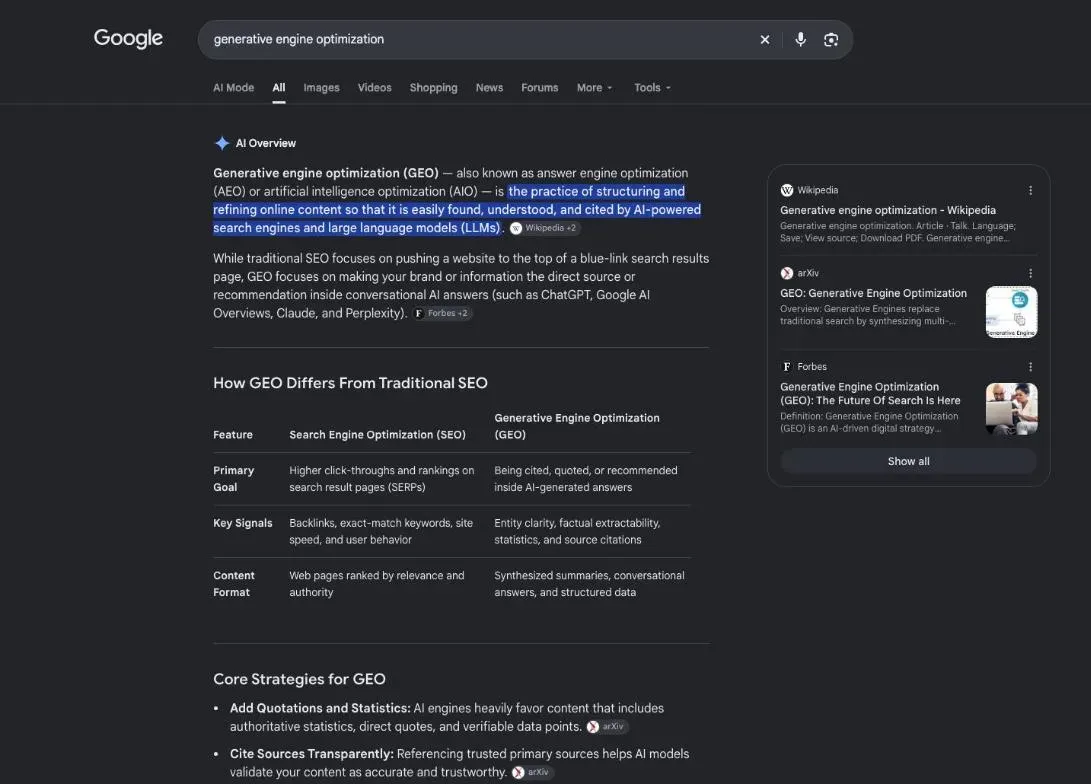
A generative engine doesn’t hand you a list of links. It writes an answer, built from several sources. ChatGPT, Gemini, Perplexity and the AI Overviews at the top of Google all work this way.
The research paper that coined the term presents GEO as a way “to aid content creators in improving their content visibility in generative engine responses” (arXiv abstract, read on 30 October 2026).
In plain words: SEO aims for a spot in the list of results; GEO aims for a spot inside the answer. To compare the two approaches side by side, read the page on GEO vs SEO. This page sticks to the term itself: what it means, where it comes from and what it asks of you.
GEO optimisation: what the word covers, and what it doesn’t
It covers the clarity of your pages, the facts you give and their sources, your reputation across the web, and whether AI crawlers can read your site at all.
It doesn’t cover a secret file, a special tag or a trick that forces an AI to quote you. Google is blunt about it on its “AI features and your website” page: no extra requirements, no special optimisation. More on that below.
It doesn’t guarantee anything either. Google writes that even a page that meets every requirement may still not be crawled, indexed or shown.
You’ll also see “GEO optimisation”. It’s redundant, since the O already stands for optimisation, but people use it and it means the same thing.
GEO in a minute
- What it is: making your content easy for AI answer engines to understand, trust and cite.
- Where it comes from: a research paper posted on arXiv in November 2023.
- What it asks of you: clear pages, sourced and current facts, a consistent presence online, real reviews.
- What it doesn’t ask: new machine-readable files or special markup, according to Google.
- How you measure it: imperfectly, for now. You ask AI tools your customers’ questions and note whether you’re cited.
Where the term GEO comes from
The research paper that named GEO
The name comes from a scientific paper titled “GEO: Generative Engine Optimisation.” Its six authors are Pranjal Aggarwal, Vishvak Murahari, Tanmay Rajpurohit, Ashwin Kalyan, Karthik Narasimhan and Ameet Deshpande.
It was first posted on arXiv, the open site where researchers share their papers, on 16 November 2023. Version 3 is dated 28 June 2024, and the page notes that the paper was accepted to the KDD 2024 conference.
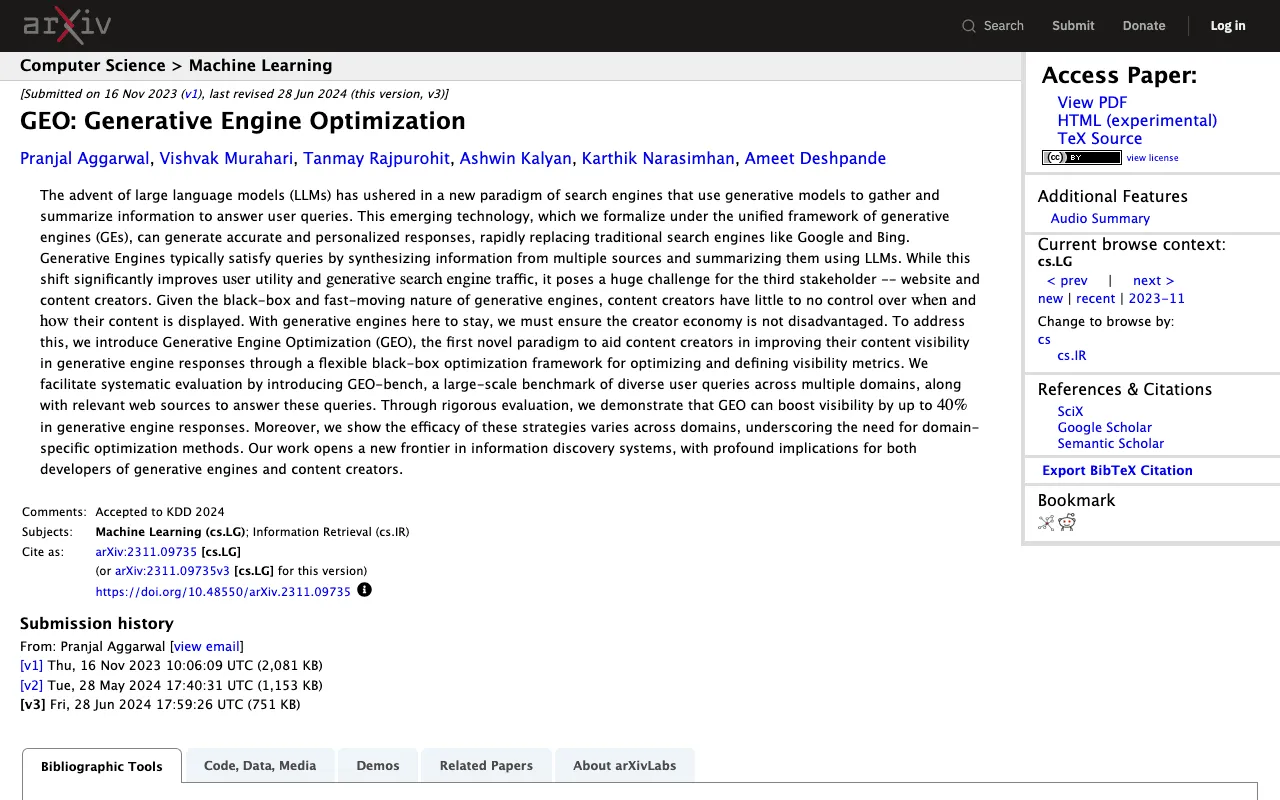
The research paper “GEO: Generative Engine Optimisation” and its six authors, on arXiv. Screenshot of arxiv.org/abs/2311.09735, taken on 30 October 2026.
The authors start from a simple observation. Generative engines summarise several sources, and website owners have little to no control over when and how their content shows up in those answers. GEO is their response: a framework to help content creators improve how visible they are.
To test it, they built GEO-bench, a large set of varied questions from many domains, paired with web pages that answer them. They then measured how changes to those pages affected their visibility in the generated answers.
What the research means for a small site
The abstract reports that GEO “can boost visibility by up to 40% in generative engine responses.” It also says the effect varies from one domain to another.
Read that number for what it is: a lab result, measured on the authors’ own benchmark, with their own visibility metrics. It is not a forecast for your site, and it says nothing about your traffic or your sales.
What a small site can take from the paper is simpler. Answer engines are now a channel worth writing for, and the way you present information changes how likely it is to be picked up. The rest of this page turns that into steps you can take this week.
Why does the term come up so often in 2026? Because these engines are now part of everyday search. Google runs AI Overviews and AI Mode, and devotes a full documentation page to them for site owners. If Google’s AI summaries are your main concern, the page on AI Overviews SEO covers how they pick their links.
How much search already happens inside AI tools in the United States? I couldn’t find a dated study I could read in full. Missing data: share of US searches made in an AI tool (planned source: a dated study, URL read).
10% off your subscription, for life with my link, if you subscribe within 2 weeks of signing up. No code. All about the SemChat promo code
Check if AI crawlers can read your site Free plan, no credit card. Affiliate link: it costs you nothing extra.
How generative engines work
From question to answer: the AI search process
France Num, the French government’s digital guide for small businesses, breaks the process into three moves (page in French, read on 30 October 2026). The engine scans a large amount of online content. It keeps the information it judges relevant and credible. Then it writes a structured answer, sometimes with its sources.
Google adds a detail about its own features. AI Overviews and AI Mode may use a “query fan-out” technique: they run several related searches across subtopics and data sources, then build one response from what they found.
So one question from your customer can trigger several searches behind the scenes. That’s one reason precise pages, each answering one clear question, are worth writing.
Each engine has its own habits. For ChatGPT specifically, see the page on how to rank in ChatGPT.
What makes content easy for AI to use
- A page worth citing
- Clarity one question, one direct answer
- Consistency the same facts everywhere online
- Current facts dated and sourced
- Reputation reviews and mentions
Nobody outside these companies knows the exact recipe. The four signals above come from France Num’s guide, and they overlap with what Google already asks for in regular search.
- Clarity: the answer in the first sentence, headings that say what each section holds. France Num lists relevance and clear writing among the criteria of AI engines. Google asks that important content be available in text form.
- Consistency: your name, business and address should match on your site, your Google Business Profile and directories. France Num notes that a mention of your brand in a reliable source counts, even without a link.
- Current facts: France Num writes that outdated content is picked up less often by AI engines. A dated price and a cited source age better than a vague claim.
- Reputation: customer reviews, forums and press coverage weigh in too, according to the same guide.
One thing you can skip. Google states: “You don’t need to create new machine readable files, AI text files, or markup to appear in these features.” An llms.txt file, in other words, is not a condition for showing up in Google’s AI answers.
The principles of GEO
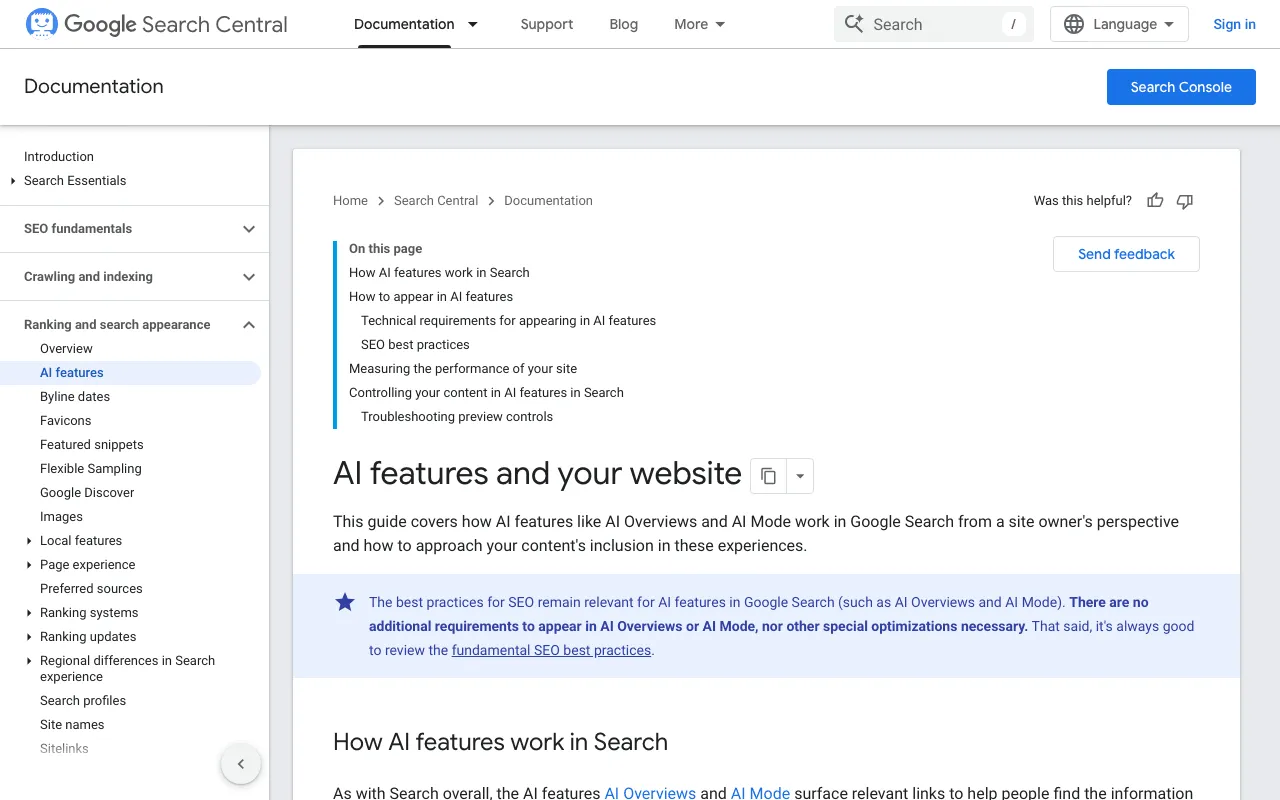
Google’s documentation: no special optimisation is needed to appear in AI features. Screenshot of developers.google.com/search/docs/appearance/ai-features, taken on 30 October 2026.
Here’s the part that saves you money. Google’s page puts it plainly (read on 30 October 2026):
“There are no additional requirements to appear in AI Overviews or AI Mode, nor other special optimisations necessary.”
And a little further down:
“You can apply the same foundational SEO best practices for AI features as you do for Google Search overall.”
France Num reaches the same conclusion, in a section whose title translates as “the principles of SEO continue to apply.” So the principles of generative engine optimisation are, first, the principles of good SEO, seen through the eyes of a machine that has to understand you before it can quote you.
Write for context and clarity
Put the answer in the first sentence, then the details. One page, one question, one complete answer.
France Num notes that AI engines care more about search intent than about exact keyword matches. It suggests building complementary pages, one per intent, starting from your customers’ real questions, such as the ones in Google’s “People also ask” box.
Short sentences and plain words help your reader first. They also leave less room for a machine to misread you.
Use authoritative, well-sourced information
Cite your sources, with their dates. Give a precise fact instead of an adjective, as long as you can source it.
France Num lists adding statistics, citing reliable sources, clear language and a readable structure among the most effective GEO levers. It’s also what makes a sentence easy to lift into an answer: one clear claim, one fact, one source.
Show who writes and why to trust them
Google’s guide to helpful content defines it this way: “People-first content means content that’s created primarily for people, and not to manipulate search engine rankings.” The same guide asks whether it’s obvious to your visitors who wrote your content.
France Num adds that AI engines lean heavily on E-E-A-T (experience, expertise, authoritativeness, trustworthiness) to judge sources. On a small site, that means an author name, a short bio, photos of your real work and proof of what you’ve done.
The concrete steps for a small site
Google’s page lists the SEO basics that stay worthwhile for its AI features:
- Make sure robots.txt, and your host or CDN, allow crawling.
- Link your pages to each other with internal links.
- Put important content in text, not only in images.
- Keep your structured data in line with the visible text.
- Keep your Merchant Center and Business Profile information up to date.
France Num’s guide adds a few habits: answer your customers’ real questions, refresh pages that have gone stale, and ask happy customers for reviews. For the full walkthrough, AI crawlers included, see the page on AI search optimisation.
GEO, AEO, LLMO: the other names
- Being used in AI answers the shared goal
- GEO generative engine optimisation
- AEO answer engine optimisation
- LLMO large language model optimisation
The same goal travels under several labels. AEO stands for answer engine optimisation. LLMO stands for large language model optimisation, after the models that power tools like ChatGPT and Gemini. In British English, you’ll read “generative engine optimisation,” with an s: same thing.
Generative search optimisation: same idea, another label
Generative search optimisation is one more name for the same work: being understood and cited by search tools that generate their answers. Different vendors favour different labels. The work behind them doesn’t change.
A related idea is the SEO agent: an assistant that runs analyses and acts on your site for you, instead of only answering. That’s a different topic, covered on the page about the SEO agent.
What GEO and SEO have in common
More than the hype suggests. To appear as a supporting link in AI Overviews or AI Mode, Google says a page must be indexed and eligible to be shown in Google Search with a snippet. No SEO basics, no GEO.
France Num calls GEO an extension of traditional SEO rather than a break from it. Both rest on the same foundations: content quality, reliable and current information, a credible source.
The difference is the target: a ranking in a list for SEO, a place in a written answer for GEO. France Num also points out that AI answers can vary from one query to the next.
If you want to use ChatGPT to help with your own SEO work, that’s the subject of the page on ChatGPT for SEO.
GEO tools and services: what to know before you pay
Agencies and software vendors now sell GEO. Before you pay anyone, keep these points in mind:
- No one can promise you a citation. Google itself says that indexing and serving aren’t guaranteed.
- Be wary of a pitch built around a special file; Google says you don’t need one for its AI features.
- Ask what is measured, in which engines, and how often.
Agency prices: I haven’t read a dated price page I could cite here. Missing data: typical price of a GEO agency service (planned source: dated agency price pages).
Measuring GEO results
Measurement is still rough. France Num admits there is no equivalent of Google Search Console for generative engines yet. Its method costs nothing: regularly ask these tools the questions your customers ask, and note whether you’re cited, how prominently, and whether your site is used as a source.
Search Console does count part of this. Sites shown in AI Overviews and AI Mode are included in the Performance report, under the “Web” search type, together with the rest of your search traffic (Google, read on 30 October 2026).
Paid tools track mentions in AI answers. From their dated profiles, prices read on 29 October 2026:
- Surfer AI Tracker: brand mentions, position in the answer, Visibility Score, share of voice, sentiment and cited sources, in ChatGPT, Gemini, Perplexity, Google AI Mode and AI Overviews. The AI Search Analytics plan costs €95 a month, or €82 a month billed annually.
- Semrush AI Visibility toolkit: mentions in ChatGPT, Google’s AI, Gemini and Perplexity. The Base plan costs €94.94 a month per domain, billed annually, with no trial. Semrush also offers a free AI Visibility Checker.
GEO at SemChat: announced, with no date yet
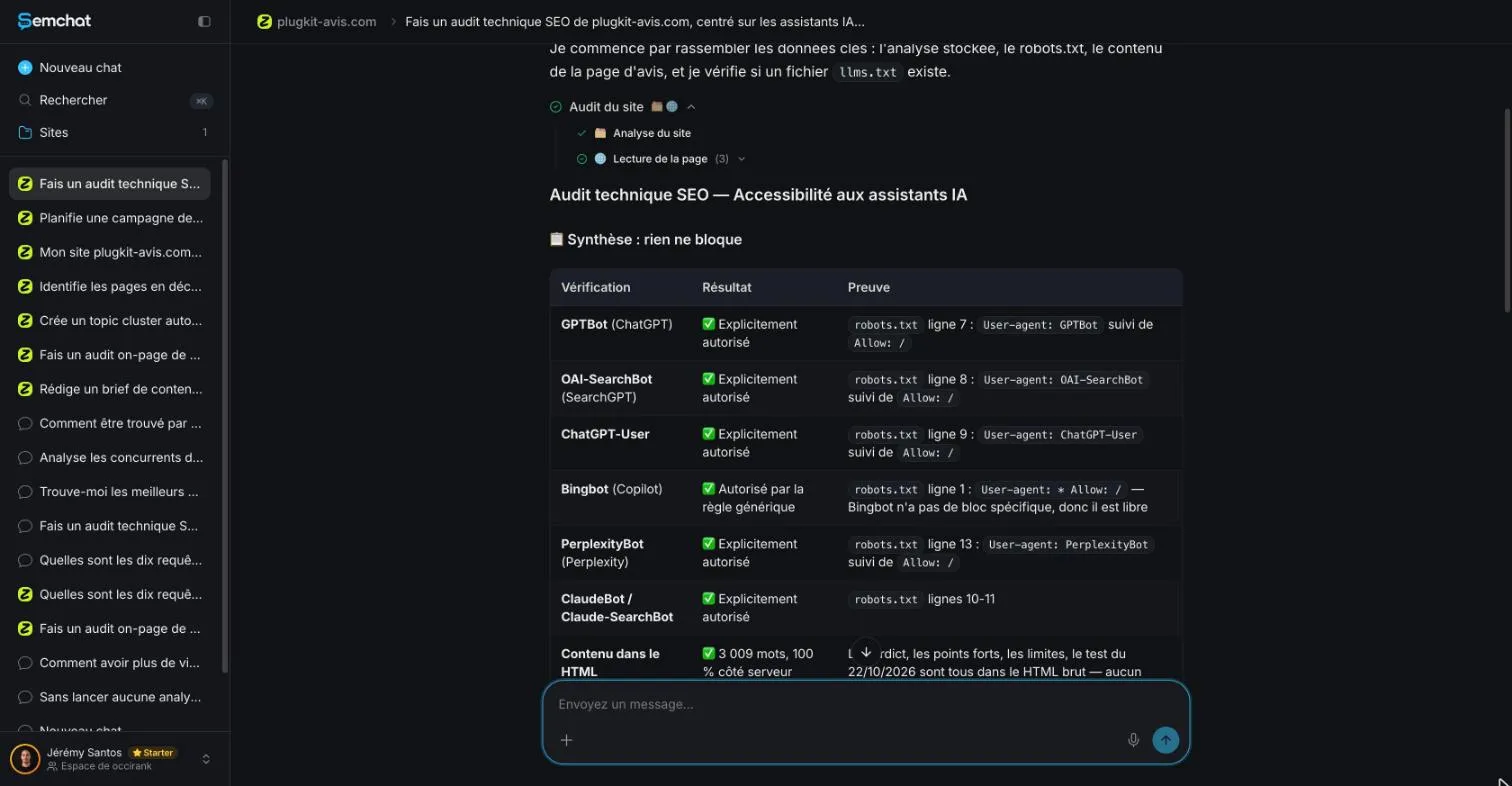
SemChat doesn’t track your citations in AI answers. The Haloscan team, which also publishes SemChat, describes GEO tracking as planned, with no date (email from Adrian Delmarre, 29 October 2026). Missing data: availability date of GEO tracking (planned source: SemChat).
What exists, and what I tested on 29 October 2026, is the Technical audit skill, which includes “AI extractability.” I asked whether ChatGPT, Copilot and Perplexity could read a page on plugkit-avis.com.
It read the robots.txt correctly (GPTBot, OAI-SearchBot, ChatGPT-User, ClaudeBot) and found the llms.txt file; I checked both by hand. It also put PerplexityBot one line off, and claimed, with no source, that Copilot is a growing share of conversational searches in France. Check its advice before you act on it; my SemChat review covers the rest.
Bottom line: generative engine optimisation is your SEO, written for a machine in a hurry that has to understand you before it quotes you. Start with one page: the question your customers ask most, answered in the first sentence, with its source.
Frequently asked questions
Is GEO better than SEO?
It isn't one or the other. Google says the best practices for SEO remain relevant for AI Overviews and AI Mode, and France Num, the French government's digital guide for small businesses, calls GEO an extension of SEO rather than a break from it (pages read on 30 October 2026). Good SEO is the foundation of GEO.
How do you implement generative engine optimisation?
Make sure search engines can crawl and index your pages, then write one clear page per real customer question, with dated and sourced facts, a named author, and the same business details everywhere online. Ask for real reviews. Then check, by asking AI tools your customers' questions, whether your site gets cited.
What is the definition of generative engine optimisation?
The research paper that coined the term presents GEO as a way to help content creators improve how visible their content is in the answers of generative engines, the tools that write a response instead of listing links (arXiv, read on 30 October 2026).
Do I need an llms.txt file for GEO?
Not for Google. Its documentation says you don't need to create new machine readable files, AI text files, or markup to appear in AI Overviews or AI Mode (read on 30 October 2026). Such a file can't replace crawlable, indexable pages.
Where does the term GEO come from?
From the research paper "GEO: Generative Engine Optimisation" by Pranjal Aggarwal, Vishvak Murahari, Tanmay Rajpurohit, Ashwin Kalyan, Karthik Narasimhan and Ameet Deshpande, posted on arXiv on 16 November 2023 and accepted to the KDD 2024 conference (arXiv page read on 30 October 2026).
Does SemChat track citations in AI answers?
Not yet. GEO tracking is announced as planned, with no date (email from Adrian Delmarre, of Haloscan, 29 October 2026). Its Technical audit skill already checks whether AI crawlers can read your page: robots.txt and llms.txt.
Let your AI do the chores of getting found online.
10% off your subscription, for life with my link, if you subscribe within 2 weeks of signing up. No code. All about the SemChat promo code
Affiliate link: it costs you nothing extra.
Verified sources
- "GEO: Generative Engine Optimization", research paper on arXiv (October 30, 2026)
- Google Search Central: AI features and your website (October 30, 2026)
- Google Search Central: creating helpful, reliable, people-first content (October 30, 2026)
- France Num: guide to generative engine optimization (in French), published February 9, 2026, updated April 24, 2026 (October 30, 2026)
- Surfer pricing (AI Search Analytics plan) (October 29, 2026)
- Surfer AI Tracker (engines tracked and metrics) (October 29, 2026)
- Semrush AI Visibility toolkit pricing (in French, prices in euros) (October 29, 2026)
- SemChat pricing (October 29, 2026)