SEO agent: what an AI agent does on its own, and what it leaves to you
An SEO agent is an AI you hand a goal, not just a question: it picks its own steps, runs its tools, reads the results and decides what to do next. It saves you time on the repetitive checks of an audit. But it gets numbers wrong, even when it names its sources, so the final review is still your job.

 By Jérémy Santos Updated on 30 October 2026 Tested on his own SemChat account: first audit on 29 October 2026.
This page is part of the guide: GEO vs SEO
You’ve heard an SEO agent will “do your SEO for you.” Before you hand your site to a robot, look at what one actually does. On 29 October 2026, I tested an assistant that chains its own tools, SemChat, on my own site, and I read the pages of the tools that call themselves agents. Links to SemChat are affiliate links; they don’t change what I say about it.
This page is part of my guide on GEO vs SEO: how to get found on Google and in AI answers. Here, one question only: what can an agent do for you, and what must it leave to you?
What is an SEO agent?
An SEO agent is an AI that gets a goal (“audit my site,” “write an article for this keyword”) and finds its own way there. It breaks the job into steps, runs its tools, reads what they return, then chooses the next step. You don’t click at every turn.
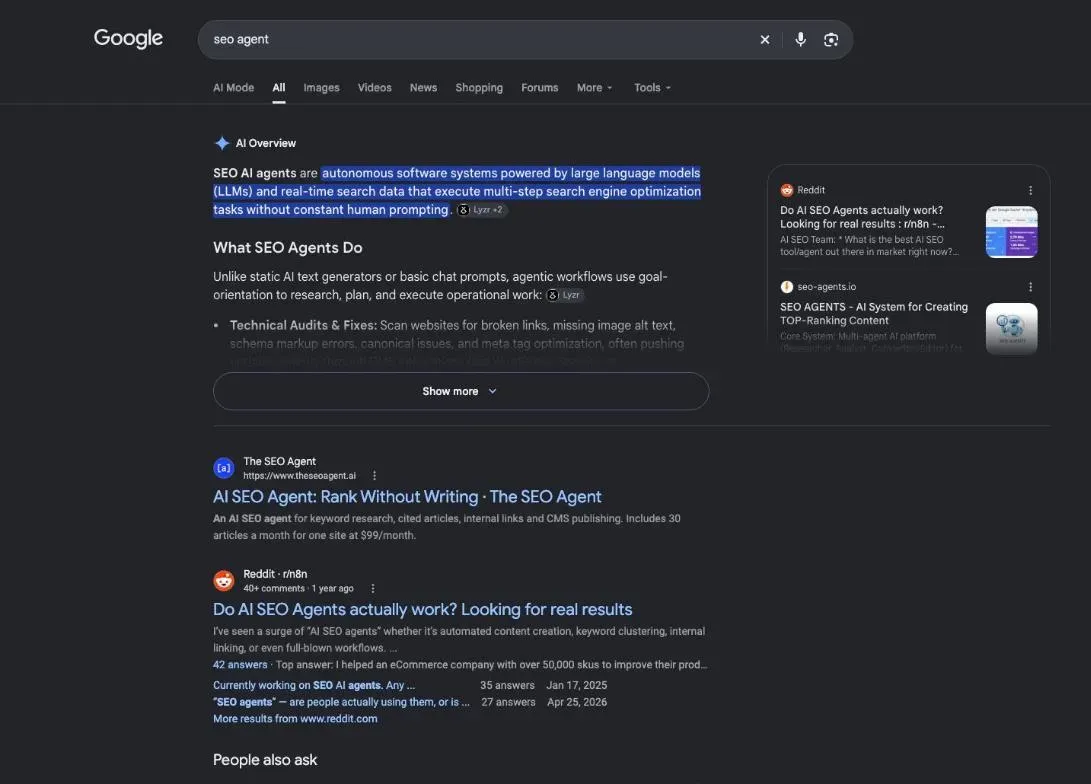
Google’s own results show how young the topic is. On 29 October 2026, the first page in the United States for “seo agent” showed videos, a local pack and questions people ask. Results 1, 3 and 5 were product pages for agents (Relevance AI, Nightwatch, The SEO Agent), and result 2 was a Reddit thread (DataForSEO, United States).
There’s no official definition. WP SEO AI calls an SEO agent “an AI-powered software assistant that automatically handles search engine optimisation tasks.” ResultFirst goes further: “autonomous AI-powered systems that have complete access to external tools” (both pages read on 30 October 2026). Those are their definitions. Mine is simpler: an agent decides what comes next.
SEO AI agent, assistant or chatbot: the difference
A classic tool shows you data; you decide what to do with it. A chatbot answers in text, from what it already knows. An assistant answers your question by running the right tools itself, then stops and hands control back. An SEO AI agent goes further: it chains several tasks and can act on your site.
| Tool | Assistant | Agent | |
|---|---|---|---|
| Who decides what's next | you, at every click | it, for the length of your question | it, from one task to the next |
| Your role | read and choose | ask, then review | set the goal, keep control |
| The risk | lost time | repeating an error | an error published without you |
ChatGPT, used for your site, is an assistant of this kind; I cover it in my guide on ChatGPT for SEO. SemChat is also an assistant, built for search: you type in plain words, it runs its tools and hands you a plan.
Agent, classic SEO tool or human specialist
A human SEO specialist knows your business, makes calls and answers for them: which pages to fix first, which keywords fit your offer, when to leave something alone. A classic SEO tool gives that person data. An agent sits in between. It moves fast and never gets tired, but it only knows your business from what you tell it, and nobody signs its conclusions.
How an AI agent works on your site
Under the hood, an agent typically runs a loop like this:
- It reads the goal you gave it, plus any context: your site, your audience, your rules.
- It plans the steps it thinks it needs.
- It calls a tool: a crawler, a rankings database, your Search Console, your CMS.
- It reads the result and decides whether to go on, try something else or stop.
- It hands you an output: a report, a draft, or a change already made.
The last step is where tools differ most. Some stop at a report. Others publish. The more an agent does without asking, the more one wrong reading costs you. My guide to automated SEO splits what an assistant reads, proposes and checks for you from what you still decide and publish.
AI agents for SEO: the tasks they handle on their own
AI agents for SEO help most on long, repetitive work that you can check afterward. Three examples.
AI agent for SEO audits: checks chained one after another
On 29 October 2026, I opened a new SemChat chat and typed one sentence (in French): “Do an SEO audit of my site plugkit-avis.com and give me a clear action plan, by priority.”
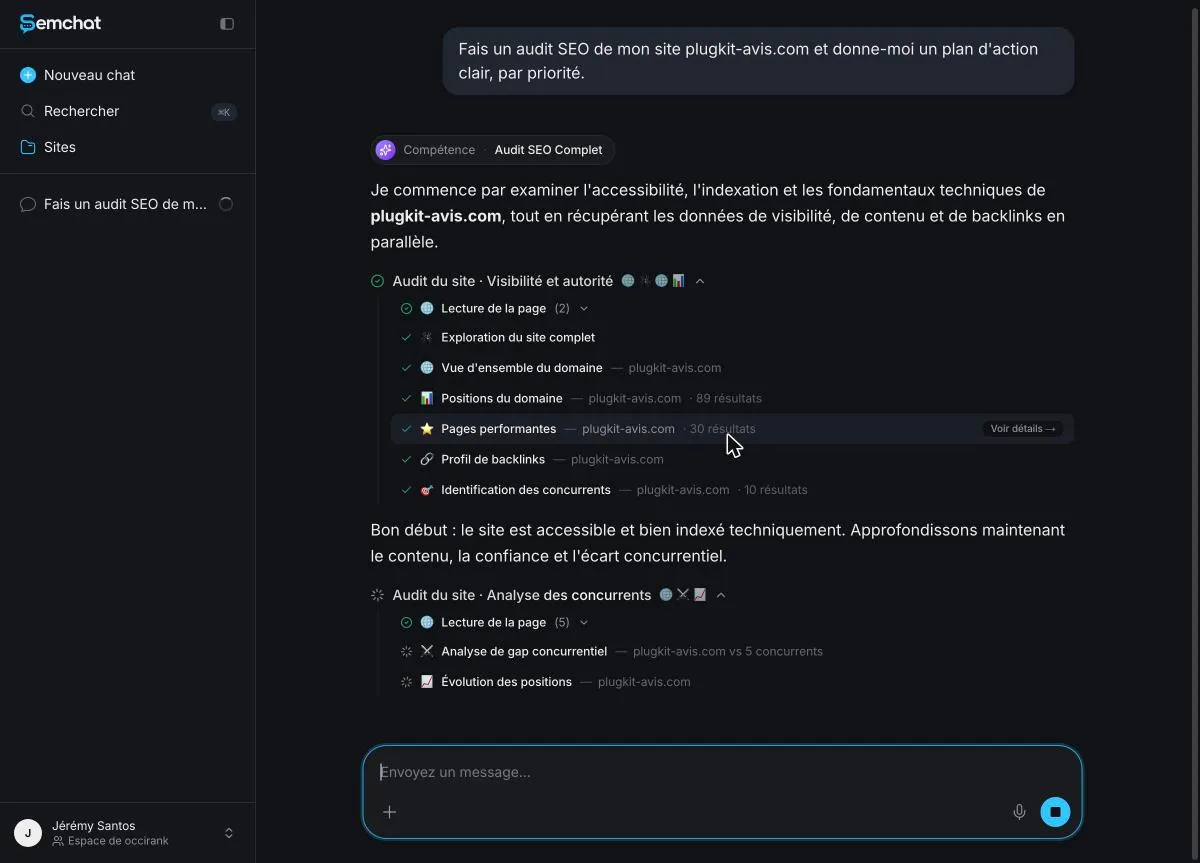
SemChat picked its own skill, “Audit SEO Complet” (full SEO audit). Then it ran its tools in two batches:
- Visibility and authority: page reads, a full site crawl, domain rankings (89 results), top pages (30), backlink profile, competitors (10).
- Competitor analysis: a keyword gap against 5 competitors, ranking history.
About 3 minutes later I had 8 key figures, a 5-point diagnosis and 3 actions for the week. I checked two findings by hand: the contact page really was missing (a 404 error), and some titles really were duplicated. That’s exactly the kind of chore you want to hand off.
The catch: that single audit used 100% of the Free plan’s monthly quota.
10% off your subscription, for life with my link, if you subscribe within 2 weeks of signing up. No code. All about the SemChat promo code
Try SemChat for free Free plan, no credit card. Affiliate link: it costs you nothing extra.
Keyword research and content briefs
Both are work an AI does fast, and both need a second look.
When I asked SemChat to group keywords, its first “difficulty” score came from ad competition, not from how hard it is to rank on Google. Once I named that problem, along with two others, it answered “Tu as raison sur les trois points” (“you’re right on all three points”), gave a proper SEO difficulty and named the source of its search volumes. Some of those volumes were still far from Google Ads figures pulled through DataForSEO, in both directions.
Its content brief was a solid 11-part document, with an internal rule banning unsourced statistics and three links to pages that really existed on my site. The same brief also suggested a section that duplicated a page already live, and one of its FAQ answers stated a fact with no source, against its own rule.
Publishing and monitoring
This is where the word “agent” earns its keep. The SEO Agent offers 30 articles a month, published after your approval or automatically, plus a weekly rank check on every page it published, for $99 a month (pricing page read on 30 October 2026). Search Atlas says its OTTO SEO applies title, schema and internal-link changes to your site, on autopilot or after approval, with a rollback option.
SemChat published nothing on its own in my tests. It has WordPress and Webflow connectors, which I haven’t connected or tested, so I can’t tell you they publish. Its rankings are the ones on the day you ask, with no scheduled tracking.
The benefits of AI SEO agents for a small team
If you run a site alone or with two people, here’s what you actually gain.
Time saved on repetitive work
An audit that chains about ten tools in about 3 minutes is time you don’t spend clicking through dashboards. The French team at Mantra says a full SEO article went from 8 hours to 32 minutes with its own agent (mantra.work, read on 30 October 2026). That’s their claim, from a team with its procedures already written down. Treat it as their result, not a promise for your site.
Cost compared with hiring help
The prices I could read are clear. SemChat: a Free plan at €0, then Starter at €20 a month before tax (pricing page read on 29 October 2026). The SEO Agent: $99 a month, with a 3-day trial at $1. Nightwatch, which has its own agent called NightOwl: from €99 a month before VAT, with a 14-day trial and no card.
What a freelance SEO consultant charges in the United States, I don’t have from a dated source, so I won’t make up a figure. Get two quotes and put them next to these numbers.
Faster decisions, with the data in front of you
The good agents don’t just give a verdict; they show the data behind it. In SemChat, each step of the audit has a “Voir détails” (see details) button that opens the raw table: 89 ranking rows for my domain, filterable, with a CSV export. You can check a claim in seconds instead of taking it on trust.
Limits and risks: where AI SEO agents get it wrong
An SEO agent writes with the same confidence whether it’s right or wrong. That’s its real flaw.
Numbers to double-check before you act
In a technical audit focused on AI assistants, I asked SemChat whether ChatGPT, Copilot and Perplexity could read my main page. It read my robots.txt file (the file that tells crawlers what they may visit) and got most lines right: GPTBot on line 7, OAI-SearchBot on line 8, Bingbot covered by the general rule on line 1.
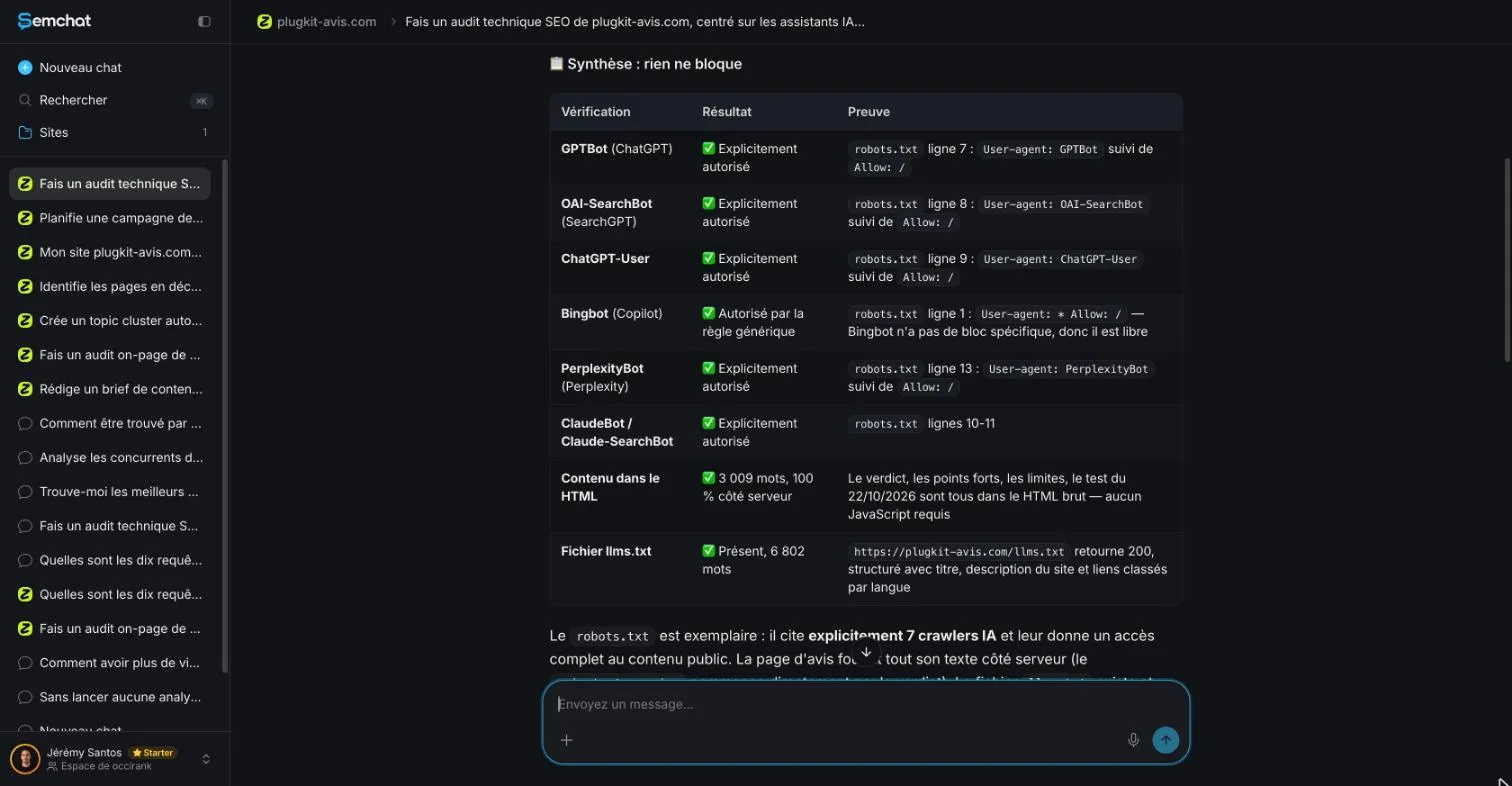
But it put PerplexityBot on line 13; it’s on line 12, and line 13 is Google-Extended. In the same answer, it claimed with no source that Copilot is a growing share of conversational searches in France. Small errors, stated as facts.
Advice that ignores what your site already has
The “one thing to fix first” in that audit was to name Bingbot in my robots.txt. It changed nothing: the general rule already let Bingbot in, as SemChat itself had written. In another audit, centered on indexing, it told me to create a sitemap file that already existed and loaded fine.
An agent that acted on that advice alone would edit your site for no reason. Before you follow any suggestion, check that the page or file isn’t already there.
Keep quality and ethics in your hands
The more serious tools build in a brake. The SEO Agent says an article with a fact its sources don’t support waits for your approval. On the other side, Outrank’s terms say links from its backlink offers go live without review: “no manual preview or approval step is provided.”
If a text goes out under your name, your customers read you, not the tool. Keep at least the last read.
How to choose an SEO agent for your site
The tools below show up in Google’s results and in the guides on SEO agents. I haven’t tested any of them: every fact comes from their official pages, read on 29 October or 30, 2026. A feature that isn’t mentioned stays “not mentioned.”
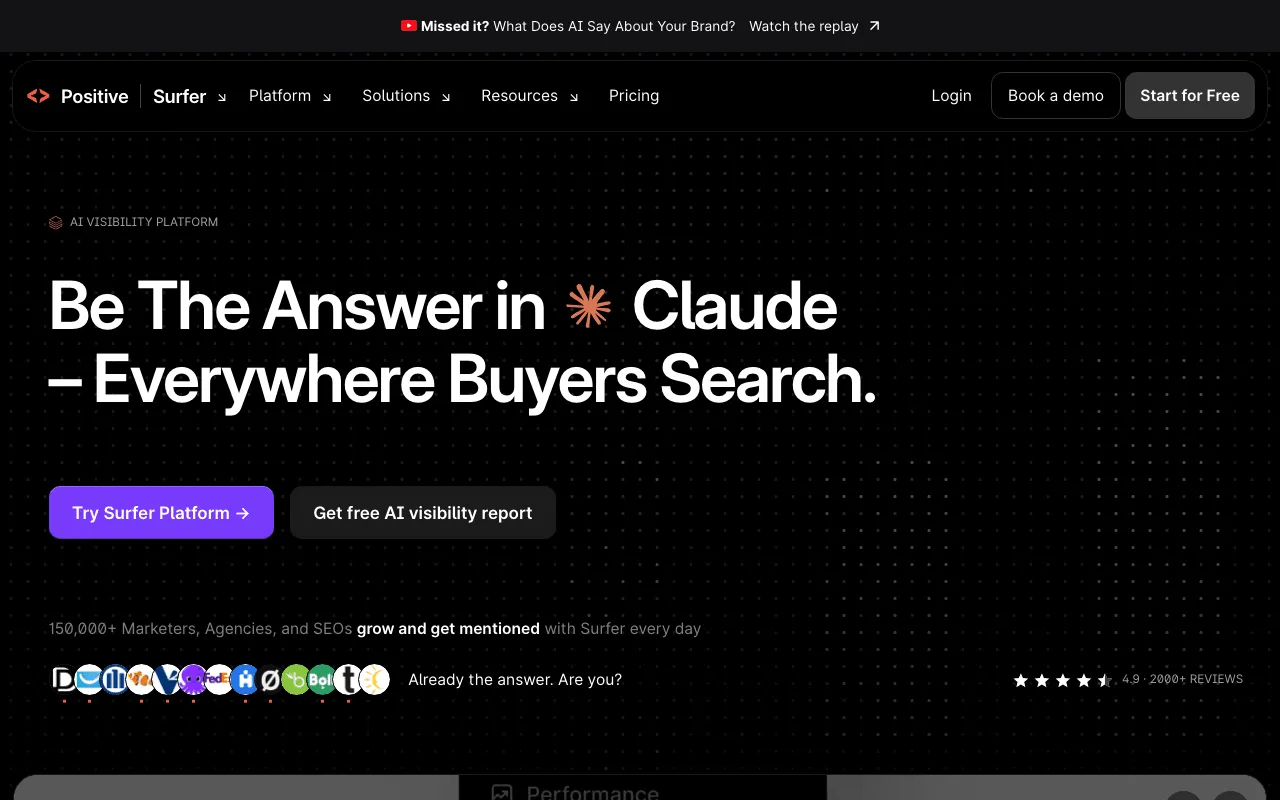
Surfer’s public home page, which presents it as an “AI Visibility Platform.” Further down the same page, Surfy Agent is announced as “(soon),” with no date. Screenshot of surfer.ai, taken 30 October 2026.
- Surfer is a writing tool first. Its assistant, Surfy, works inside the text editor on a passage you select; its AI Instructions page says it’s “Not a chatbot or a general-purpose AI assistant.” The real agent, Surfy Agent, is only announced. Its first plan, Discovery, costs €59 a month before VAT, with no free plan.
- Relevance AI is a platform for building your own agents, with six SEO agent templates to clone. Its pricing page shows only an Enterprise offer, with no public price.
- The SEO Agent writes and publishes for you, from a 30-day content plan built on your Search Console. Its site doesn’t describe any built-in chat.
- Nightwatch tracks rankings and AI answers, and its NightOwl agent works through a chat. It doesn’t mention publishing to a CMS.
- Search Atlas has a conversational agent, Atlas Agent, and OTTO SEO, which changes your pages directly. Its 7-day trial requires a card.
Pick by the last step: do you want a report you act on, or changes made for you? The second saves more time and costs more when it’s wrong.
Before you sign up anywhere, ask four questions:
- Can you see its sources? A finding you can’t check is a finding you can’t trust.
- Does it ask before it publishes? Look for an approval step, and for a way to undo a change.
- Is it built for your size? Relevance AI shows only an Enterprise offer, and Nightwatch’s plans are counted in hundreds of tracked keywords.
- Can you try it without a card? A free plan or a no-card trial lets you test it on your real site first.
Free SEO AI agents and open-source projects
I won’t name an open-source project I haven’t read, dated and checked. What I can tell you is what’s free in the tools above: SemChat’s Free plan at €0, Make’s free plan at $0, Nightwatch’s 14-day trial without a card, and The SEO Agent’s free Chrome extension and domain audit. None of them is an agent that works for free month after month.
Agents built into WordPress or no-code tools
Some agents live inside your CMS: WP SEO AI presents its own as working “within your content management system.” Others you build in a no-code tool. Make links Search Console, an AI model and WordPress in a “scenario,” and its assistant Maia builds that scenario from a plain-language description. n8n is often named in the same breath; I haven’t read its pages, so I won’t describe it.
Make isn’t an SEO tool, and its pages show no SEO feature ready to use. You build everything yourself, with an account and a key for each service.
Is SemChat an SEO agent?
Not in the sense of an autonomous agent. SemChat is a conversational assistant, and the difference matters for you.
| SemChat chains on its own | Stays in your hands | |
|---|---|---|
| Audit | picks its skill, runs its tools | checks each finding before acting |
| Data | rankings, pages, backlinks, competitors | cross-checking volumes and claims |
| Your site | an action plan by priority | making the changes, publishing |
| Follow-up | today's rankings, when you ask | tracking results over time |
An assistant that chains its own tools during an audit
During a task, SemChat behaves like an agent: it picks its skill, runs about ten tools and assembles a plan. Then it stops and hands control back. In my tests it didn’t change or publish anything on my site, and it didn’t come back on its own the following week. My SemChat review covers the full test, numbers included.
MCP servers: a door open, not tested yet
An MCP server is a standard plug that gives an AI new tools. SemChat accepts a “custom connector” to any standard MCP server, with an address and a token. I haven’t plugged one in, so I can’t tell you how it behaves. SemChat doesn’t expose an MCP server of its own either, for another AI to drive it.
What stays in your hands
- Deciding and editing your site: SemChat suggests, you apply.
- Checking the numbers before you reuse them.
- Tracking results over time: it gives today’s rankings, not a schedule.
- Your visibility in AI answers: its technical audit checks whether AI crawlers can read your page; its GEO feature is announced as planned, with no date (email from Adrian Delmarre, of Haloscan, 29 October 2026). For the term itself, see my page on generative engine optimisation; for practical steps, my guide to AI search optimisation.
SEO agents and the future of SEO work
Agents will take on more of the legwork: crawling, pulling data, drafting. The judgment part stays human, for now, because nobody controls what an AI chooses to cite. That’s also why I don’t promise you results on how to rank in ChatGPT or on SEO for AI Overviews with any single tool.
Stay curious and test small
Start with one task you already know how to check, like an audit of your own site. Compare the agent’s findings with your Search Console. Keep what’s right, note what’s wrong, and only then give it more room. Budget-wise, SemChat’s Free plan is €0 and Starter is €20 a month before tax: details on my SemChat pricing page. Save your first full audit for your real site, since it uses up the month’s quota.
An SEO agent won’t replace your judgment or your final review. Take the speed it gives you, check what it claims, and keep your hands on anything that touches your site.
Frequently asked questions
How can AI help with your SEO work?
It's fastest on long, repetitive, checkable work: running an audit, pulling your rankings and backlinks, comparing you with competitors, drafting a content brief. In my test on 29 October 2026, SemChat turned one typed sentence into an action plan in about 3 minutes. Then check every number before you act on it.
How do you build an SEO AI agent?
You connect a data source (Google Search Console, a keyword tool), an AI model and your CMS, then write the steps and the checks it must pass. Make lets you assemble those blocks by describing them to its assistant, Maia, and has a free plan. You still need an account and a key for each service, and someone to watch the errors.
Is SemChat an autonomous SEO agent?
No. SemChat is a conversational assistant. During a task it picks its own skill and runs its own tools, like an agent would, then it stops and hands control back. In my tests it didn't change or publish anything on my site, and its AI visibility (GEO) feature is announced as planned, with no date.
Can an SEO agent replace a human SEO specialist?
Not for decisions. In my tests, SemChat read most lines of a robots.txt file correctly, then put one crawler on the wrong line and suggested a top-priority fix that changed nothing. An SEO agent does the legwork fast; someone still has to sort right from wrong. That someone can be you.
Let your AI do the chores of getting found online.
10% off your subscription, for life with my link, if you subscribe within 2 weeks of signing up. No code. All about the SemChat promo code
Affiliate link: it costs you nothing extra.
Verified sources
- SemChat pricing (October 29, 2026)
- What is a SEO agent? (WP SEO AI) (October 30, 2026)
- What Are AI SEO Agents and How Do They Work? (ResultFirst) (October 30, 2026)
- Surfer home page (Surfy Agent announced as coming soon) (October 30, 2026)
- Surfer AI Instructions (October 29, 2026)
- The SEO Agent pricing (October 30, 2026)
- The SEO Agent: SEO automation (October 30, 2026)
- Relevance AI SEO Agent (October 30, 2026)
- Relevance AI pricing (October 30, 2026)
- Nightwatch SEO AI agent (October 30, 2026)
- Nightwatch pricing (October 30, 2026)
- Search Atlas OTTO SEO (October 29, 2026)
- Search Atlas Atlas Agent (October 29, 2026)
- Outrank terms of use (October 30, 2026)
- Make pricing (October 30, 2026)
- Make: Maia (October 30, 2026)
- Mantra: deploying an AI agent for SEO (in French) (October 30, 2026)