How to choose keywords for SEO: the criteria, without jargon
How to choose keywords for SEO, in one line: keep the searches that enough people type (volume), that you can realistically rank for (difficulty), that match what the searcher wants (intent) and that fit what you sell (relevance). Four questions per keyword, and a small site wins on long, precise searches first.
 By Jérémy Santos Updated on 30 October 2026 Tested on his own SemChat account: first audit on 29 October 2026.
This page is part of the guide: Keyword research tool

Choosing the right words puts your shop window where people look. Illustration by Zéro Corvée.
You write, you publish, and Google sends almost nobody. Often the writing isn’t the problem: the target is. Learning how to choose keywords for SEO puts your shop window where people actually look. This page is part of our keyword research tool guide, and it covers the choosing part.
Only our SemChat and Haloscan links are affiliate links. They don’t change prices or our advice.
Keywords and SEO: how they connect
SEO is how you show up in Google without paying for ads. Keywords are the searches you want to show up for. Without a chosen keyword, a page aims at nothing in particular, and Google has no clear reason to show it.
Can a keyword be a whole sentence?
Yes. A keyword is whatever someone types: “plumber Austin”, “how to descale a kettle”, “best stand mixer for bread”. Many of the most useful keywords are full questions.
Are keywords still important for SEO?
They are. Google’s page on AI features in Search says “The best practices for SEO remain relevant for AI features in Google Search” (read 30 October 2026). People still type words; your page still has to answer them.
How to choose keywords for SEO: start from your goals
Before any tool, write down what a visitor should do on your site: call you, book, buy, subscribe. Then list the searches a person types just before doing that. Those are your first keywords. Everything else is a bonus.
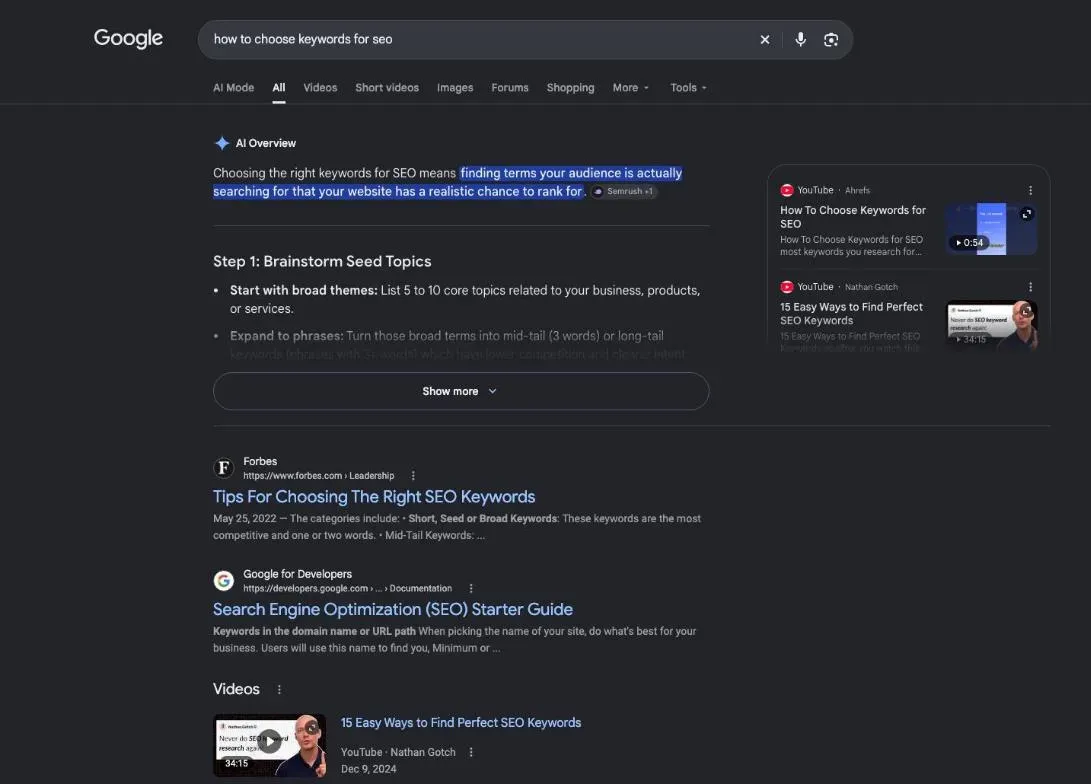
A shop owner and a blogger won’t pick the same way. The shop needs searches close to a purchase (“emergency plumber near me”). The blogger needs questions their readers ask, plus a few pages that recommend or compare, the ones that earn money.
The criteria for choosing keywords, explained simply
Ask four questions about every keyword on your list. If one answer is bad, move on.
- 1 Volume Do enough people search it?
- 2 Difficulty Can you beat today's top results?
- 3 Intent Does the searcher want what you offer?
- 4 Relevance Does it fit your business?
Volume: how many people look for it
Volume is the average number of searches per month. A real example: this page targets “how to choose keywords for seo”, searched about 260 times a month in the United States (DataForSEO Labs, 29 October 2026). Small, but enough for one focused page.
Tools rarely agree on volume. Our guide to search volume shows real gaps and how to read them.
Difficulty: who already holds the top spots
Each tool computes its own difficulty score, so compare scores from one tool only. On this site we use DataForSEO Labs’ KD (0 to 100) for English. “How to choose keywords for seo” scores 15; “keyword research tool” scores 81 (29 October 2026). The first is within reach of a small site; the second is a fight with the biggest SEO brands.
No score is a Google rule. The honest test: search the keyword yourself. If page one is all national brands and official sites, the spot is expensive. If you see forums and thin pages, you have a chance.
Intent: what the searcher wants to find
Two close searches can hide different needs. “How to build a website” wants a guide; “website design cost” wants a quote. If your page answers the wrong need, the visitor leaves. Our guide to keyword intent covers it in depth.
Relevance: does the keyword fit your business
A keyword can have volume, low difficulty and clear intent, and still be useless to you. “Free logo maker” brings people who don’t want to pay a designer. Keep the searches that can end with someone choosing you.
A worked example: one keyword through the four questions
Say you run a small bakery and you’re weighing “custom birthday cakes”. Volume: about 4,400 searches a month in the United States (DataForSEO Google Ads, 30 October 2026), so people want it. Difficulty: search it and look at page one; if local bakeries and small sites show up, you can compete in your city. Intent: the person wants to order, which is exactly your job. Relevance: you bake custom cakes. Four green lights: this keyword gets its own page, with photos, prices and a way to order.
Now try “how to make a birthday cake at home”. Volume may be higher, the intent is to learn, and the reader wants to bake it themselves. It can still be a useful blog post, but it won’t sell a cake this week. It goes lower on your list.
Why long-tail keywords suit a small site
Long-tail keywords are longer, more precise searches. Each one brings fewer people, but the need is clear.
| Broad search | Long-tail search | |
|---|---|---|
| Example | running shoes | running shoes for flat feet women |
| Need | unclear | very clear |
| Who ranks | big retailers | specialists and small sites |
What long-tail keywords bring you
Less competition, and visitors who know what they want. A new site rarely wins a broad search; it can win twenty precise ones. Several long-tail searches often fit on the same page.
How to find long-tail keywords
Type your topic into Google and read the autocomplete. Add “for”, “near”, “without”, “best”, “how much”. The “People also ask” box is a free list of long-tail questions. Our page of SEO keyword examples shows measured lists for a shop, a blog and a store.
Where to find keyword ideas, free or paid
Free ways: Google’s suggestions and Keyword Planner
Google’s own tool is Keyword Planner. Google calls it “a free resource”, but its help page adds: “You must complete your account setup by entering your billing information” to reach the basic features (read 30 October 2026). You also need a campaign created. Our page is Google Keyword Planner free walks through it.
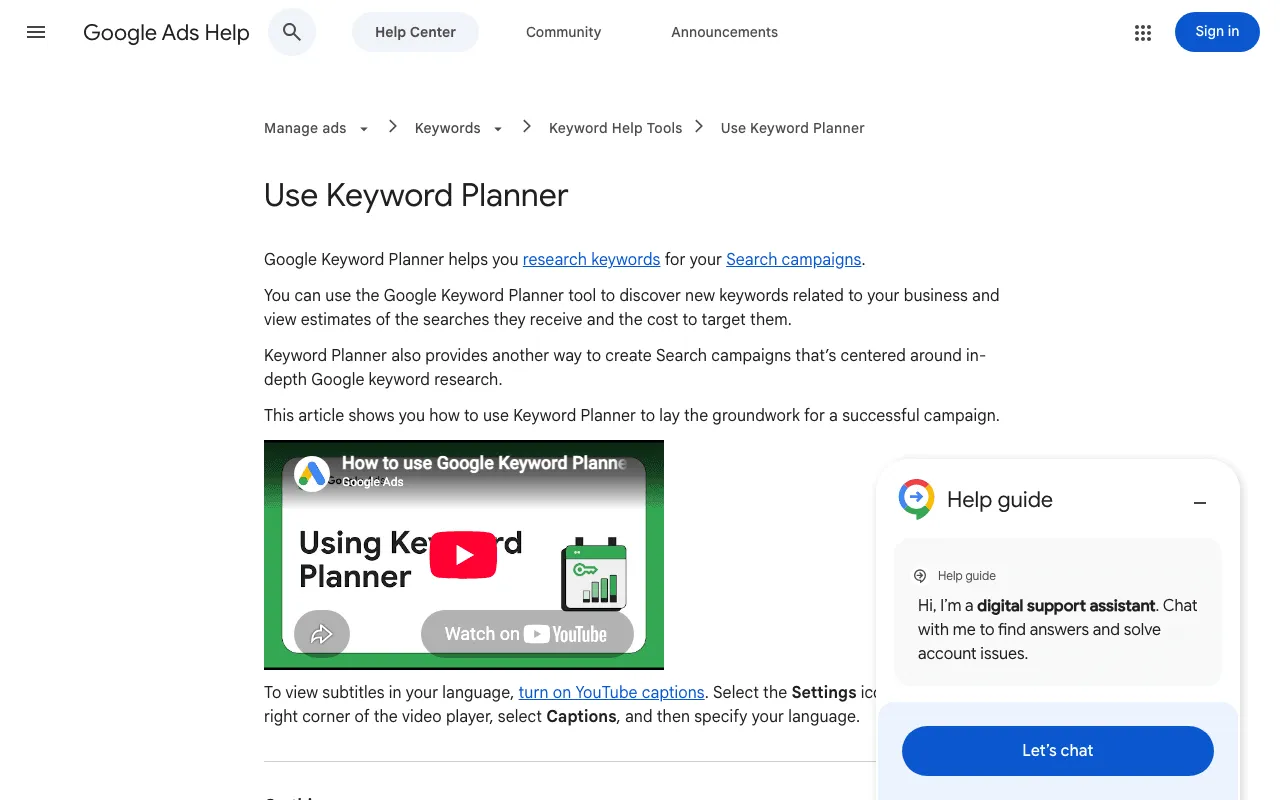
Google Ads help page “Use Keyword Planner”. Screenshot of support.google.com/google-ads/answer/7337243, taken 30 October 2026.
Paid keyword tools
Semrush Free gives 10 reports a day; its SEO plan costs €134 a month, plus taxes (fact sheet, 29 October 2026). Ubersuggest keeps a free plan with 3 searches a day; Individual costs €29 a month. For a small site, free tiers are often enough to start.
What your competitors already rank for
The sites that rank for your keywords show what Google rewards. Our guide to competitor keyword research shows how to find the searches where they beat you.
Asking SemChat to sort your keywords, and what to check
SemChat works the other way round: you describe your business, it searches. On 29 October 2026, Jérémy tested it on his French site, in French. After he pointed out three errors, SemChat gave the source of its volumes (its own database, a 12-month rolling average, France) and an SEO difficulty based on the top 10 results.
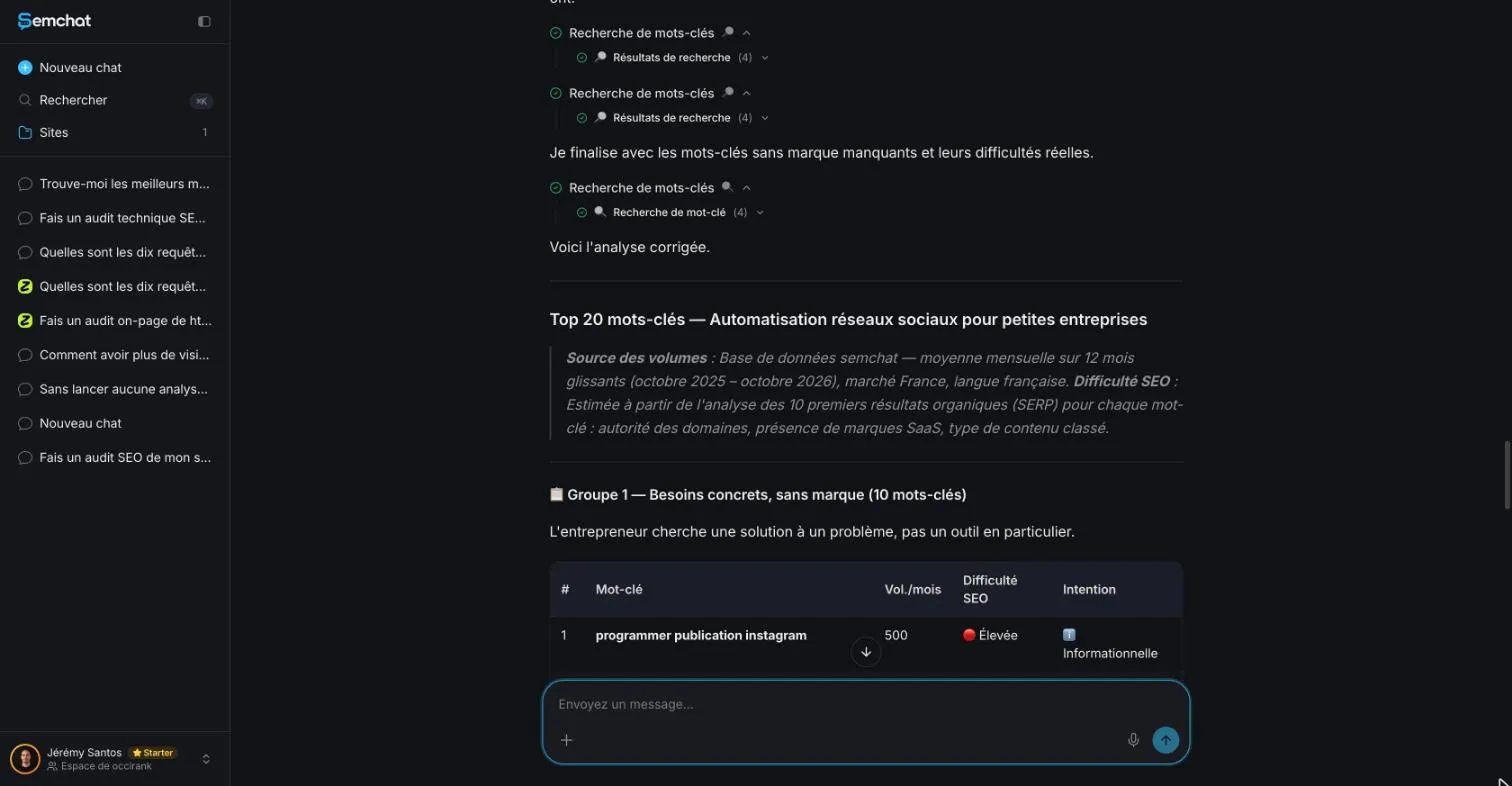
After correction, SemChat gives the source of its volumes and an SEO difficulty. Screenshot of the SemChat app (Jérémy’s account, interface in French), 29 October 2026.
What to check: before the correction, its “difficulty” came from ad competition, and its volumes were sometimes far from DataForSEO Google Ads (France): “hootsuite gratuit”, a French keyword, at 655 against 140. Cross-check before you commit. Our full SemChat review covers the rest of the test.
Use your keywords, then check how they do
Google’s guidance is clear: its systems “are designed to prioritise helpful, reliable information that’s created to benefit people” (read 30 October 2026). Put the keyword in the title, the main heading and the first paragraph, then write for the reader.
Update old pages before writing new ones
If a page of yours already shows up for a keyword, improve it instead of writing a second page on the same need. Our guide to check website keywords shows where to look.
Track your chosen keywords over time
Search Console’s Performance report shows your clicks, impressions and average position per query; its default view covers the past three months (help page, read 30 October 2026). That’s your free tracking.
SemChat’s audit gives a snapshot of your positions on the day, exportable as CSV: 89 rows for Jérémy’s site. A scheduled position tracking isn’t established on its product pages, so don’t count on it for that.
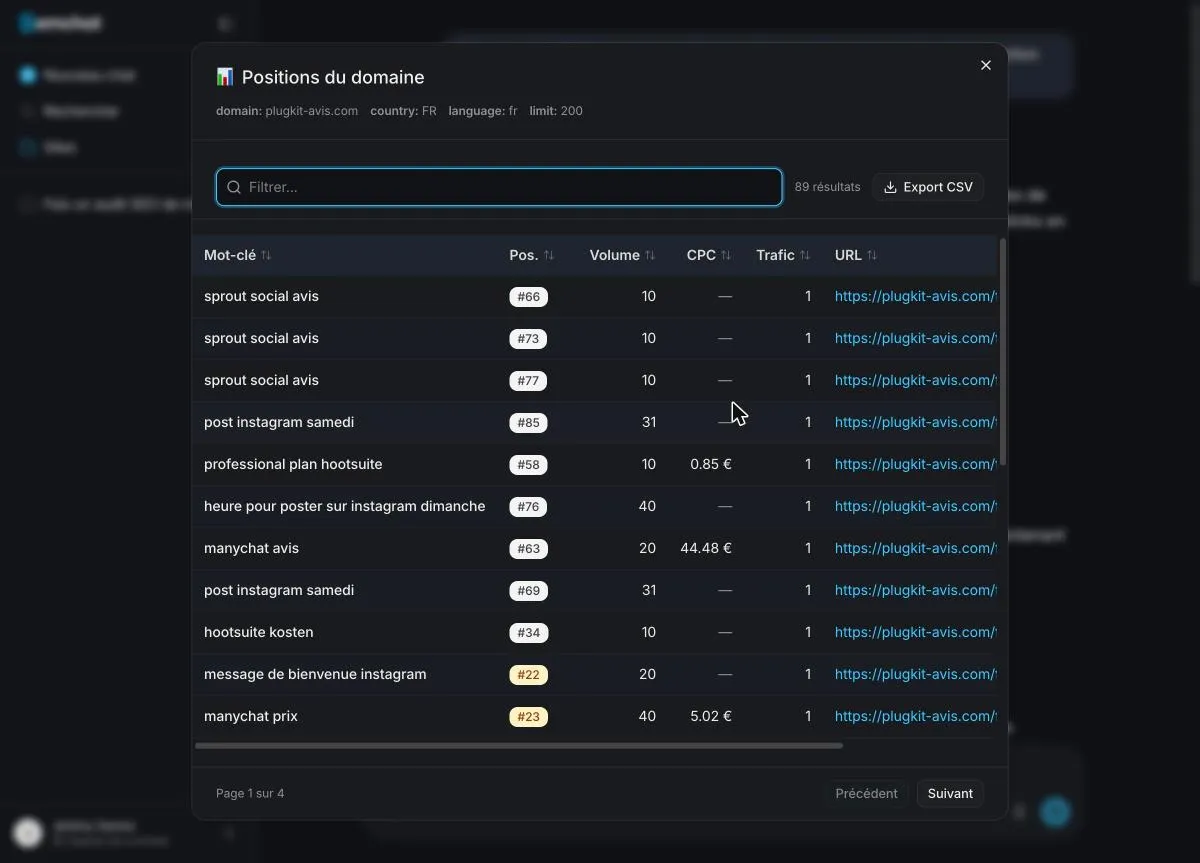
Today’s positions of a site in SemChat, a snapshot rather than tracking. Screenshot of the SemChat app (Jérémy’s account, interface in French), 29 October 2026.
So, how to choose keywords for SEO comes down to four questions: volume, difficulty, intent, relevance. Start with precise searches close to a sale, give each its own page, and check the results in Search Console every month.
Frequently asked questions
How do you generate keywords for SEO?
Start with your customers' own words, then expand them with Google's autocomplete, the "People also ask" box and related searches. A free generator (Ahrefs' Keyword Generator, Ubersuggest's free plan) or Google Keyword Planner then adds ideas with their monthly volume.
How do you choose the right keywords for SEO?
Score each keyword on four questions: do enough people search it, can you outrank the current top results, does the searcher want what your page offers, and does it fit your business. Keep the ones that pass all four, starting with those closest to a sale.
Is SEO dead or evolving in 2026?
Evolving. Google's documentation on AI features in Search says the best practices for SEO remain relevant for AI Overviews and AI Mode, with no special optimisation required (read 30 October 2026). Choosing the right keywords and answering them well still comes first.
How many keywords should one page target?
One main keyword, plus a few close variations of the same need. Two pages chasing the same keyword compete with each other, so give each need its own page.
Let your AI do the chores of getting found online.
10% off your subscription, for life with my link, if you subscribe within 2 weeks of signing up. No code. All about the SemChat promo code
Affiliate link: it costs you nothing extra.
Verified sources
- Google Ads Help: Use Keyword Planner (October 30, 2026)
- Google Ads: Keyword Planner page (FAQ) (October 30, 2026)
- Google Search Central: creating helpful, reliable, people-first content (October 30, 2026)
- Google Search Central: AI features and your website (October 30, 2026)
- Search Console Help: Performance report (October 30, 2026)
- Semrush pricing (October 29, 2026)
- Ubersuggest pricing (October 29, 2026)
- SemChat pricing (October 29, 2026)