Keyword intent: read what the searcher wants before you write
Keyword intent is what the person wants when they type a search: to learn, to compare, to buy or to reach a specific site. To find it, type the keyword into Google and count the page types at the top: guides, comparisons, product pages, tools. Then build your page in the same format, only better.
 By Jérémy Santos Updated on 30 October 2026 Tested on his own SemChat account: first audit on 29 October 2026.
This page is part of the guide: Keyword research tool

Behind every search, a wish: to learn, to compare, to buy. Illustration by Zéro Corvée.
Two people type almost the same words and want completely different things. One wants to learn, the other wants to buy. Keyword intent is that hidden goal behind the words. If your page answers the wrong goal, the visitor leaves. This page is part of our keyword research tool guide, and it teaches you to read intent before you write.
Only our SemChat links are affiliate links. They don’t change prices or our advice.
What keyword intent means
It’s the reason someone types a search. “How to descale a kettle”: they want a method. “Best kettle descaler”: they’re comparing products. “Buy kettle descaler”: they’re ready to pay.
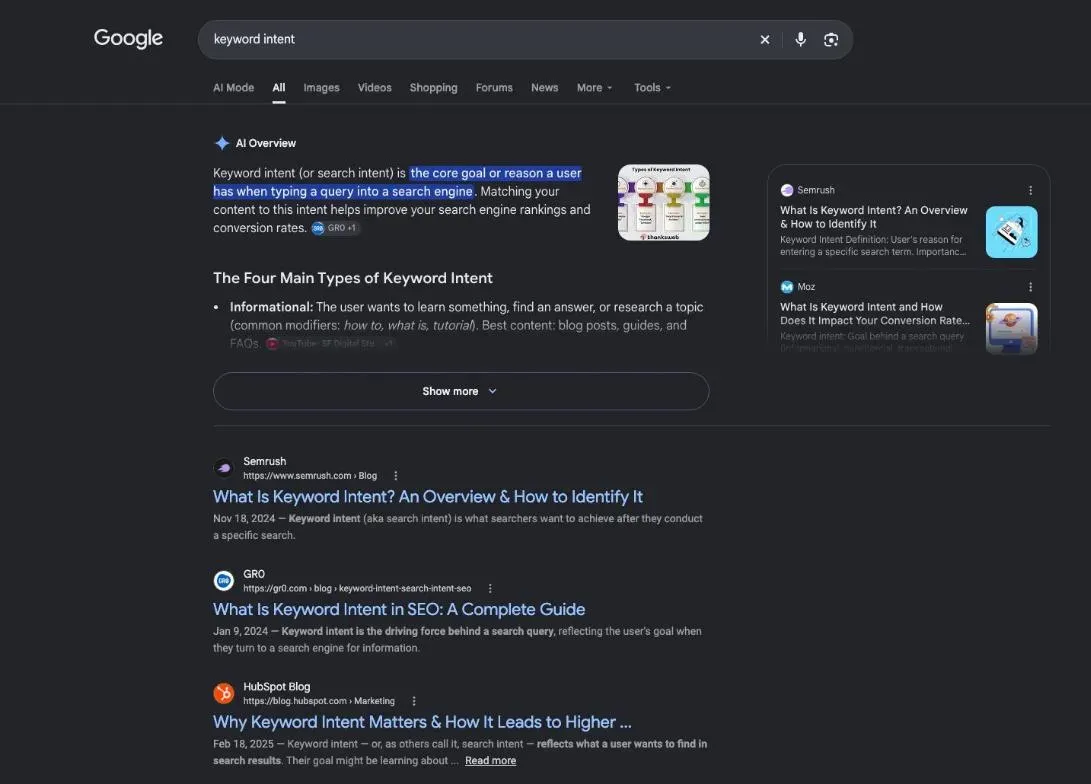
Why intent matters for your rankings
Google says its systems are “designed to prioritise helpful, reliable information that’s created to benefit people” (read 30 October 2026). A page that misses the intent doesn’t help, however good the writing. A long guide on a search where Google only shows product pages rarely climbs.
Why most small sites get it wrong
They pick a keyword for its volume, then write the page they wanted to write. The result: a blog post where Google expects a product page, or a sales page where people want a how-to. Our guide on how to choose keywords for SEO puts intent among the four checks for every keyword.
Keyword intent types: learn, compare, buy, find a site
| Intent | Typical words | Page that answers | |
|---|---|---|---|
| Learn | Informational | how to, why, what is | Guide, how-to |
| Compare | Commercial | best, review, vs | Comparison, review, list |
| Buy | Transactional | price, buy, free, quote | Offer page, product page |
| Find a site | Navigational | brand name, login | Home page, account page |
Informational: the searcher wants to learn
“How to grow tomatoes”, “what is SEO”. No purchase yet. Answer with a clear guide, with the answer in the first lines.
Commercial: the searcher compares before buying
They know what they want but weigh options: “best cordless vacuum”, “Semrush review”. An honest comparison or a hands-on review fits.
Transactional: the searcher is ready to act
Buy, book, sign up, ask for a quote. Words like “price”, “buy”, “free” or “coupon” often signal it. They need an offer page with the price and the button.
Navigational: the searcher wants a specific site
“Semrush login”. Unless it’s your brand, don’t bother targeting these.
One keyword, several intents
Sometimes the top results mix types. That means Google sees several needs behind one search. The winning page often covers both: it explains, then shows the options.
How to find a keyword’s intent by reading Google
No tool replaces this: look at what Google shows. Here’s the method we follow for every page on this site.
Step 1: type the keyword and read the top results
Search in a private window, in the country you target. Read the top ten organic results, not the ads. Note the extras too: “People also ask”, videos, a map, an AI answer.
Step 2: note the type, format and angle of each page
Label each result: guide, how-to, list, comparison, review, product page, tool, forum, video. The most frequent type gives the main intent. A real example from our DataForSEO check of 29 October 2026 (United States): for “keyword research tool”, 5 of the top 10 were tools; for “keyword intent” itself, 4 were how-tos and 3 were guides. People want to learn.
An AI assistant can help read the results, as long as you check its numbers. In one test, SemChat’s on-page audit correctly saw that Google rewards pages giving the answer right away, a point we confirmed in DataForSEO’s results the same day. But a figure it gave about competitors’ titles didn’t match those results, so we left it out.
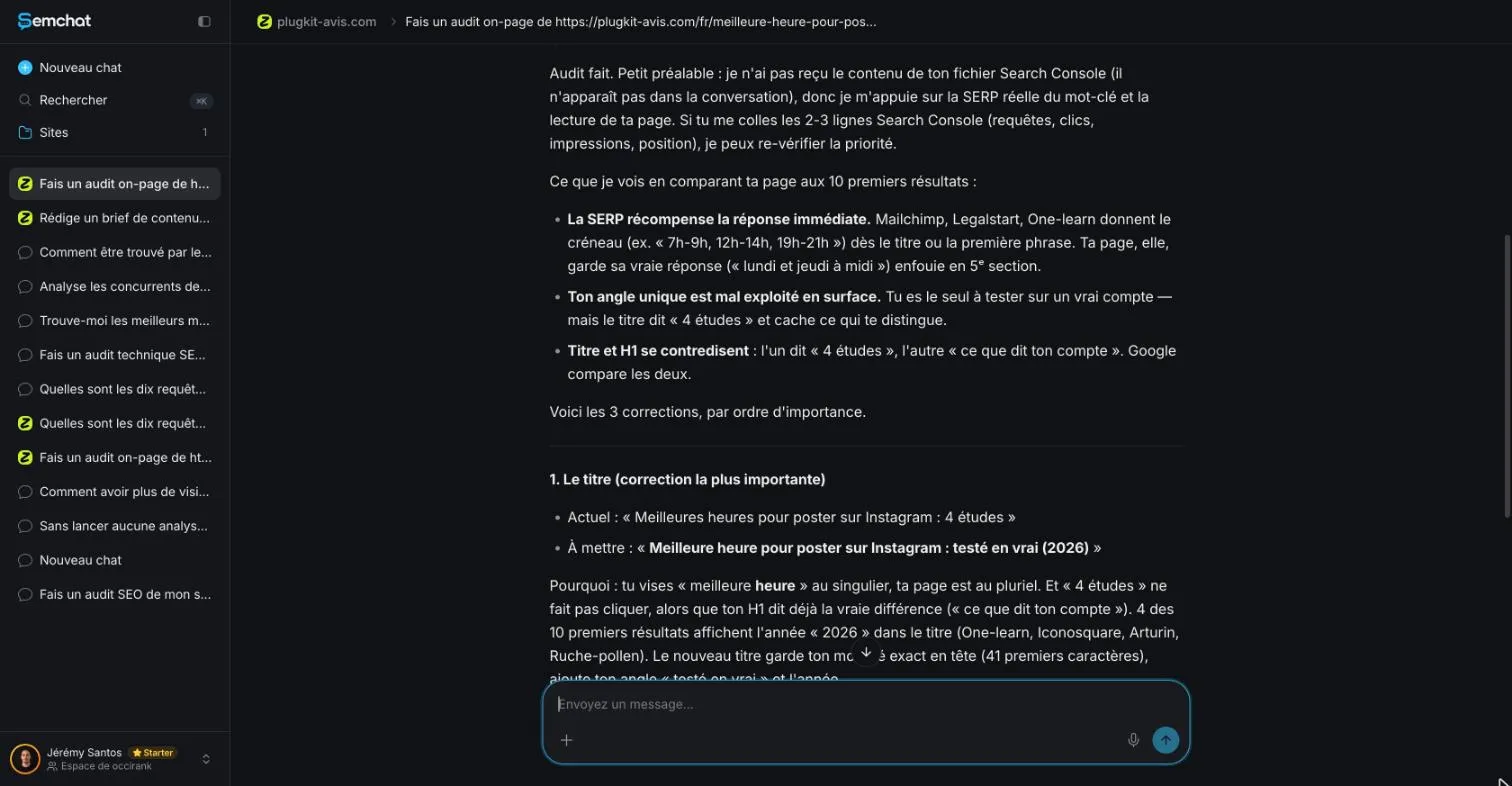
SemChat’s on-page audit reads what the results reward before suggesting a title. Screenshot of the SemChat app (Jérémy’s account, interface in French), 29 October 2026.
Step 3: list the subtopics the top pages share
Open the top three results and note their headings. What they share is what the reader expects. Cover it, then add what they lack: a real example, a photo, a test. Our page of SEO keyword examples shows how a measured list adds that.
Keyword intent checker tools
SemChat gives intent with volume and difficulty
SemChat, an SEO assistant you talk to, returns each keyword’s intent in the same table as volume and difficulty. In our test of 29 October 2026, on French keywords about a French topic, it grouped keywords by need, each with its intent, after correction.
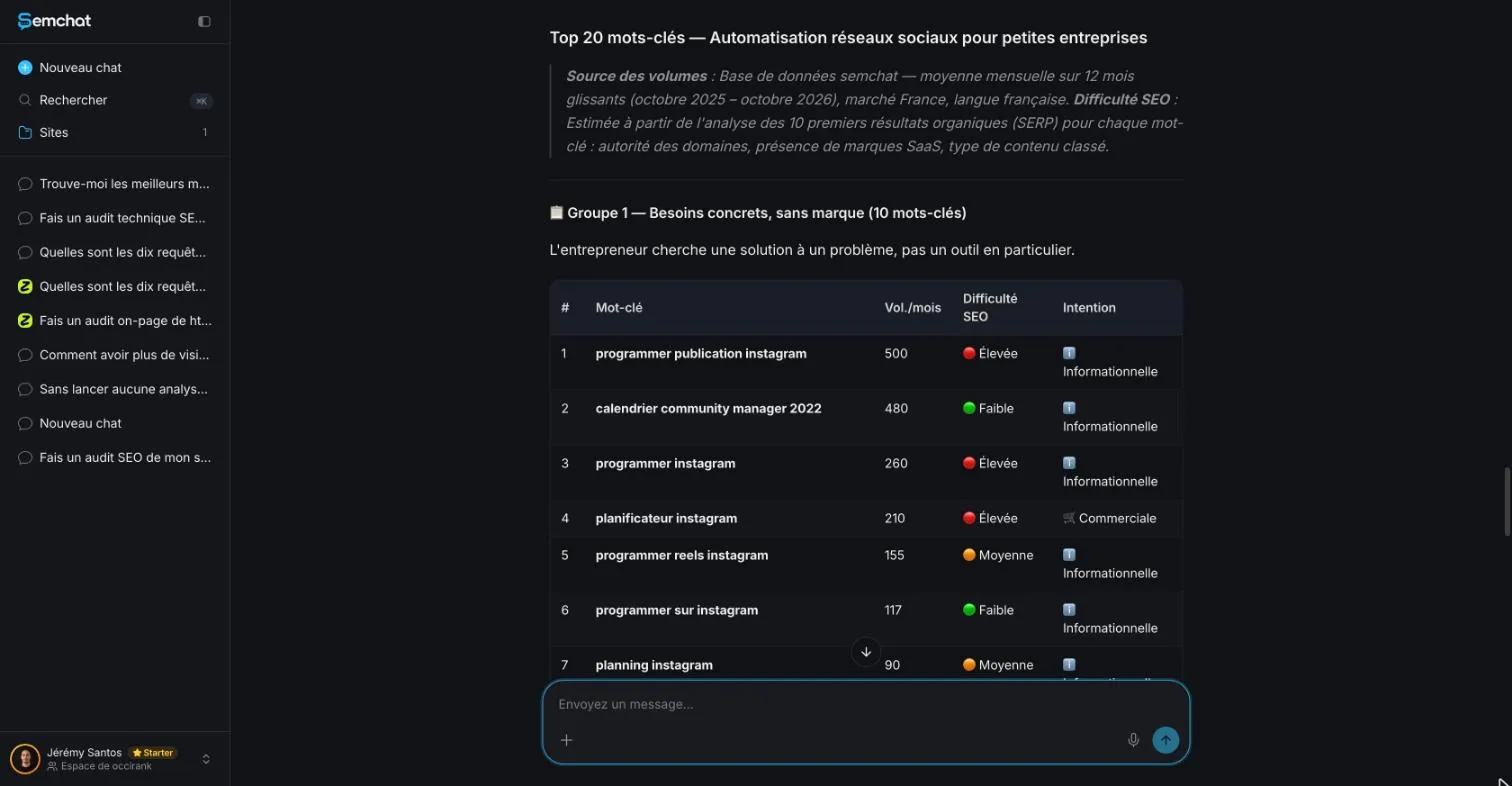
SemChat gives each keyword’s intent next to its volume and difficulty. Screenshot of the SemChat app (Jérémy’s account, interface in French), 29 October 2026.
Cross-check the volumes: “hootsuite gratuit” showed 655 a month against 140 in DataForSEO Google Ads, and “swello gratuit” 110 against 20 (France, 29 October 2026). Outside France, SemChat’s team told Jérémy by e-mail that its keyword data comes from a mix of providers they didn’t name; we haven’t checked its quality for the United States. Our SemChat review has the full test.
Read volume and difficulty next to intent
Intent alone isn’t enough: people must search, and you must be able to rank. Our guide to search volume explains the number, and is Google Keyword Planner free shows Google’s free tool.
Which page fits which intent
Match the format to the dominant type. Mostly guides: write a guide. Mostly comparisons: compare honestly. Mostly product pages: an article won’t win, build an offer page. Once the format is set, our guide to SEO content writing shows you how to structure the page and write it for a person. To see which intents your rivals already cover, use competitor keyword research, then check which queries your own pages show for with our guide to check website keywords.
Intent for your pages and for your ads
The same reading works for ads. Keyword Planner shows a top-of-page bid for each keyword: compare a learning search with a buying search and you’ll see what advertisers think each visitor is worth. For organic pages, searches close to a sale are where your best visitors come from.
Intent behind spoken searches
Spoken searches tend to be full questions. The method doesn’t change: type the question and read the results. We don’t have a sourced figure on voice search share, so we won’t give one.
Keyword intent in the age of AI Overviews
Google’s page on AI features says: “You can apply the same foundational SEO best practices for AI features as you do for Google Search overall” and “There are no additional requirements to appear in AI Overviews or AI Mode, nor other special optimisations necessary” (read 30 October 2026). Reading intent and answering it well still comes first.
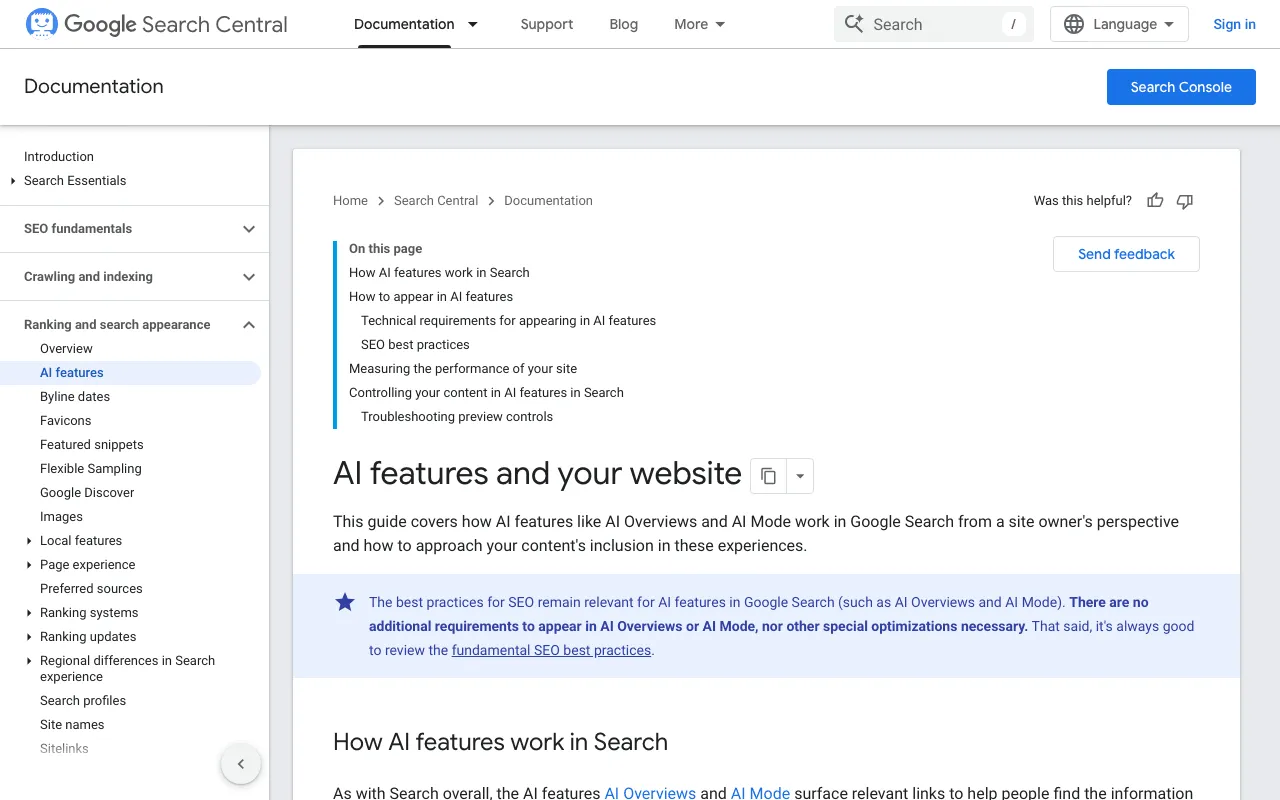
Google’s page on AI features and your website. Screenshot of developers.google.com/search/docs/appearance/ai-features, taken 30 October 2026.
So keyword intent is read in Google before it’s written on your page. Search the keyword, count the page types at the top, match the format, and answer better than the rest.
Frequently asked questions
What is keyword intent in SEO?
It's the goal behind a search: learning something, comparing options, buying or acting, or going to a specific site. In SEO, you match the page to that goal: a guide for learning, a comparison for choosing, an offer page for buying.
Can you list the different types of keyword intent?
Four are usually named: informational (learn), commercial (compare before buying), transactional (buy or act now) and navigational (reach a specific site). Local searches, like "plumber near me", are often treated as a fifth case.
Which keyword strategies fit each intent?
Informational searches call for guides and how-tos that answer fast. Commercial searches call for honest comparisons and reviews. Transactional searches need offer pages with the price and a clear button. Navigational searches are only worth targeting if it's your own brand.
Can one keyword have several intents?
Yes. When the top results mix guides and product pages, the intent is split. Pick the intent that dominates the top results, or the one that serves your business, and answer it clearly.
Let your AI do the chores of getting found online.
10% off your subscription, for life with my link, if you subscribe within 2 weeks of signing up. No code. All about the SemChat promo code
Affiliate link: it costs you nothing extra.
Verified sources
- Google Search Central: AI features and your website (October 30, 2026)
- Google Search Central: creating helpful, reliable, people-first content (October 30, 2026)
- SemChat pricing (October 29, 2026)