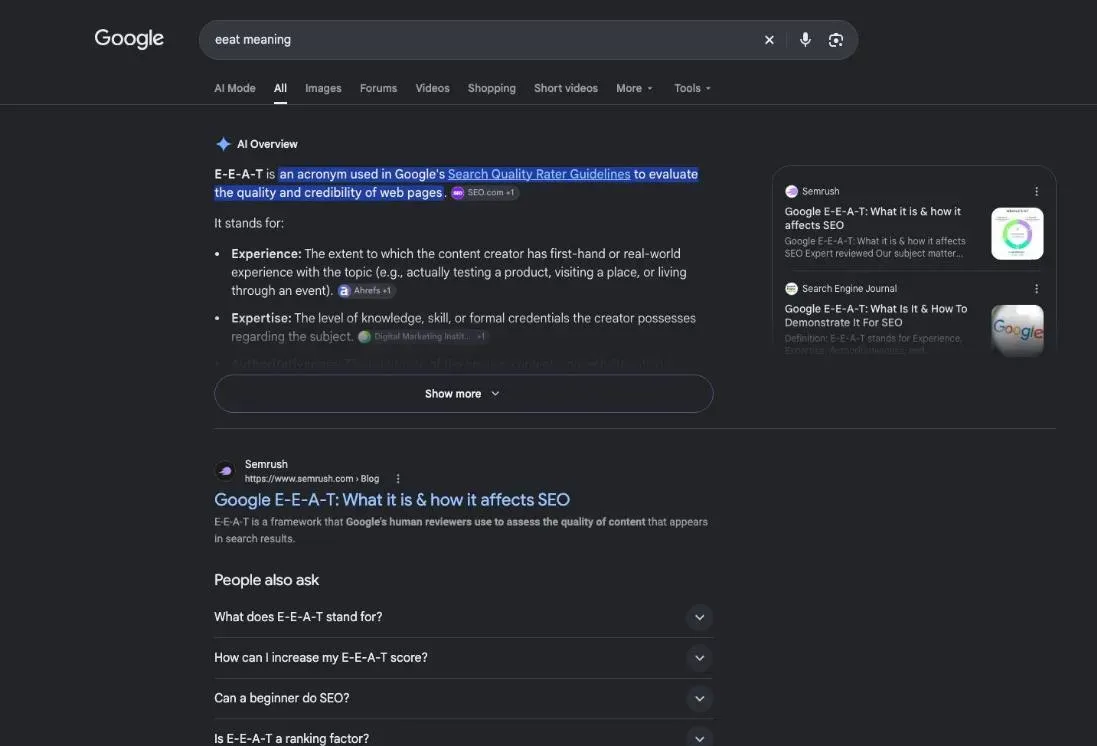
EEAT meaning: what Google means by trust, and how to show it
EEAT meaning, in one line: experience, expertise, authoritativeness and trust, the four things Google looks for to decide whether a page deserves to be believed. Google says trust matters most, and that EEAT isn't a ranking factor of its own. You show it with proof of what you've lived, a named author and dated sources.
 By Jérémy Santos Updated on 30 October 2026 Tested on his own SemChat account: first audit on 29 October 2026.
This page is part of the guide: website optimisation

Show who writes, what they have lived, and why to believe them. Illustration by Zéro Corvée.
Two websites sell the same stand mixer. The first one copies the maker’s product sheet. The second shows three failed cakes, then the good one, with photos and dates. You already know which one you believe. Google wants to know too, and the EEAT meaning is exactly that: a way to tell who deserves trust.
This page is part of our website optimisation guide. Everything I say here about Google comes from its own pages, read 30 October 2026. The SemChat buttons on this page are affiliate links.
What is EEAT? Google’s yardstick for trust
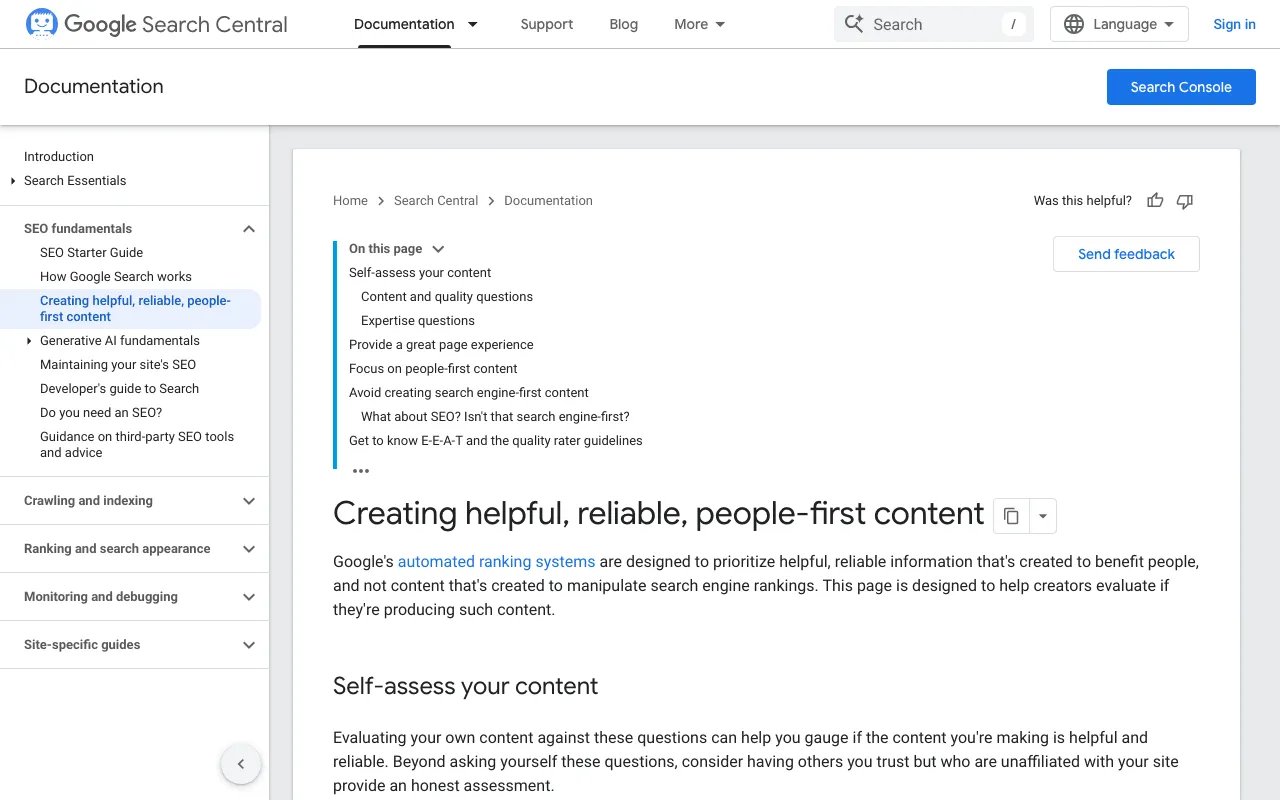
Google explains it on a page of its documentation called “Creating helpful, reliable, people-first content.” Its systems, it writes, look for content that shows “experience, expertise, authoritativeness, and trustworthiness, or what we call E-E-A-T.”
E-E-A-T: what each letter stands for
Each letter is one question about the person or site behind a page:
- Experience: have you lived what you write about?
- Expertise: do you know the subject?
- Authoritativeness: do others turn to you on this subject?
- Trustworthiness: is the page accurate, honest, safe and reliable?
Until late 2022, it was E-A-T, without the first E. On 15 December 2022, Google’s blog announced: “E-A-T is gaining an E: experience.” Google added that these “are not fundamentally new ideas.” If an article still says E-A-T, it was simply written before.
EEAT Google guidelines: who reads them
Google has people check its results. In its words: “Search quality raters are people who give us insights on if our algorithms seem to be providing good results.” They follow a long document, the Search Quality Evaluator Guidelines: 182 pages in the 11 September 2025 version I read on 30 October 2026.
Raters don’t rank your page. Google is clear: “Search raters have no control over how pages rank.” It compares them to “feedback cards from diners” in a restaurant. Still, their guidelines are the best description of what Google calls a good page, and Google says reading them may help you self-assess your content.
EEAT meaning, letter by letter
The rater guidelines don’t treat the four letters as equals. They write: “The most important member at the center of the E-E-A-T family is Trust.” The other three help you judge it.
- Trust an accurate, honest, safe and reliable page
- Experience you have done what you write about
- Expertise you know your subject
- Authority others cite you
Experience: you have done what you write about
The guidelines ask a simple question: which would you trust, “a product review from someone who has personally used the product or a “review” by someone who has not?” Google asks creators the same thing: does your content show first-hand expertise, “for example, expertise that comes from having actually used a product or service, or visiting a place”?
For a baker who runs a recipe blog, experience is the photo of her own batch, her oven setting, the day the dough didn’t rise and why. Nobody can copy that.
Expertise: you know your subject
This one is about knowledge. The guidelines’ example says it all: for rewiring a house, you trust “a skilled electrician,” not an antique homes enthusiast who knows nothing about wiring.
Not every subject needs a diploma, though. Google notes that someone sharing a new way to clear their driveway of snow “generally doesn’t necessarily require specialised expertise.” Your expertise is your trade: the carpenter knows floors, the shop owner knows her products.
Authority: others cite you
Authority means being the source people go to on a subject. The guidelines give two examples: the official government page for renewing a passport, and, for what’s on sale today, a local business’s page on social media.
Trust: honest, safe, reliable pages
Google sums it up: “Of these aspects, trust is most important. The others contribute to trust, but content doesn’t necessarily have to demonstrate all of them.”
The guidelines are blunt: untrustworthy pages have low E-E-A-T “no matter how Experienced, Expert, or Authoritative they may seem.” Their example: a financial scam is untrustworthy, even if it’s run by a very experienced scammer.
What is EEAT in SEO: a quality standard, not a score
Google doesn’t measure it like a setting on your page. Its documentation says: “While E-E-A-T itself isn’t a specific ranking factor, using a mix of factors that can identify content with good E-E-A-T is useful.” Its SEO Starter Guide puts “Thinking E-E-A-T is a ranking factor” under “Things we believe you shouldn’t focus on,” with a short answer: “No, it’s not.”
None of the Google pages I read for this guide gives a score, or a way to get one. A tool that shows you an “EEAT score” gives you its own estimate. Useful to spot gaps, as long as you check them.
Money and health topics: where Google asks for more
Google writes that its systems “give even more weight to content that aligns with strong E-E-A-T for topics that could significantly impact the health, financial stability, or safety of people, or the welfare or well-being of society.” It calls them “Your Money or Your Life” topics, or YMYL.
A recipe blog isn’t judged like a site that tells you where to invest. If you write about money or health, your sources and your credentials matter even more.
EEAT and AI-written content
Google doesn’t ban AI. It asks why the page exists: “People-first content means content that’s created primarily for people, and not to manipulate search engine rankings.” Using automation “for the primary purpose of manipulating search rankings” is against its spam policies.
Raters judge effort, too. Google writes that using generative AI “to produce large amounts of text without manual oversight or curation represents little to no effort.” If AI helps you write, add what it can’t: your test, your photos, your review of every fact.
Good and bad EEAT: examples
Two made-up pages on the same subject, to show the difference.
A page that earns trust
A local bike shop writes about choosing a commuter bike. The article is signed by the owner, with a link to a page about her and her shop. It shows photos of bikes they actually repaired, and dates its prices. The contact page gives a street address, a phone number and opening hours. Customers’ reviews on other sites mention the shop by name.
A page that loses it
Another site publishes the same topic with no author, no date, and photos copied from the brands. It praises one bike in every paragraph and links to it with an affiliate link, without saying so. The guidelines warn about exactly this: ““reviews” from an influencer who is paid to promote the product are not as trustworthy due to the conflict of interest.”
How to show EEAT on a small site
You can’t just claim EEAT. You show it, and a small site already has most of what it needs.
EEAT signals a small site can show: real proof, a named author, dated sources
Start with the “Who.” Google writes: “Something that helps people intuitively understand the E-E-A-T of content is when it’s clear who created it.” It asks: “Do pages carry a byline, where one might be expected?” No fake author, though: making up profiles with “AI-generated headshots, made-up names, or false credentials” is deception, in Google’s words.
Then the “How.” For product reviews, Google says trust grows when readers see how the tests were done, “accompanied by evidence of the work involved, such as photographs.”
Then the sources. Cite where each number comes from, and date your pages honestly: Google lists changing dates “to make them seem fresh when the content has not substantially changed” as a warning sign. How to write and update the page itself is covered in our guide to SEO content writing, and its title in our page on the SEO title.
Reviews, legal pages and a way to contact you
Raters look at what you say about yourself, but also at what others say about you: independent reviews, articles, mentions. They stay careful: “Be skeptical of both positive and negative reviews.”
What’s expected depends on what you do. The guidelines say “Online stores need secure online payment systems and reliable customer service,” and contact details are “extremely important for websites that handle money.” A clear contact page, an email that gets answered, complete legal pages: that’s the base. The rest of the page checks are in our guide on what on-page SEO is.
Links from respected sites in your field
Authority builds slowly: other sites mentioning you, people searching for your name, links pointing to your pages. Those links are called backlinks. To see who already links to you, start with a tool to check backlinks.
A real example: the EEAT of this site
I owe you the same transparency I recommend. Here’s how this site applies EEAT, limits included.
A lived test, with screenshots
This site earns a commission if you subscribe to SemChat through my links. That’s the conflict of interest the guidelines warn about. My answer: say it at the top of every page, test SemChat in my own account, and publish what it got wrong. On 29 October 2026, its full audit of plugkit-avis.com used the Free plan’s whole monthly quota. Between that test and SemChat’s own course the same day, 13 of its 17 skills ran in real conversations, with dated screenshots. The details are in our SemChat review.
The author: Jérémy Santos, creator of the Haloscan MCP server
I sign every page. I’m an SEO and AI consultant, the founder of OcciRank, and a trainer. I wrote Haloscan’s MCP server, which lets Claude talk to Haloscan’s keyword data: Haloscan’s official blog, in its tutorial of 8 September 2025 (in French), says it was created as a volunteer project for the SEO community by Jérémy Santos. My background and links are on my author page, linked from the author box on every page.
On 29 October 2026, I asked SemChat’s EEAT audit to judge the trust pages of plugkit-avis.com, my other site. Its first gap, and the one thing to fix first: no photo of Jérémy Santos on the author page.
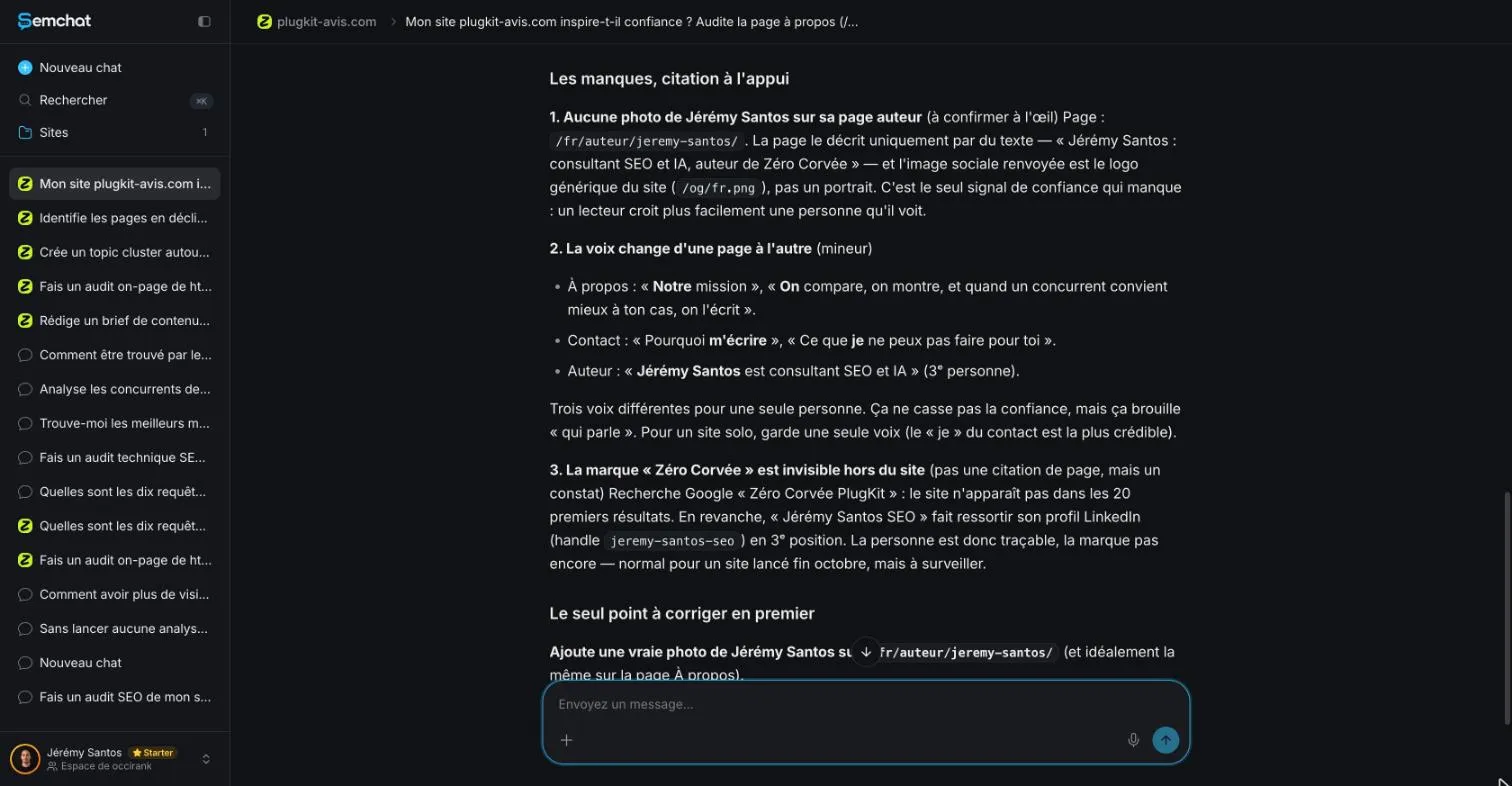
That point is false. The author page shows a portrait, with the alt text “Portrait de Jérémy Santos…” (portrait of Jérémy Santos), and its structured data declares an image of the person (the Person.image field). I checked the page’s code the same day.
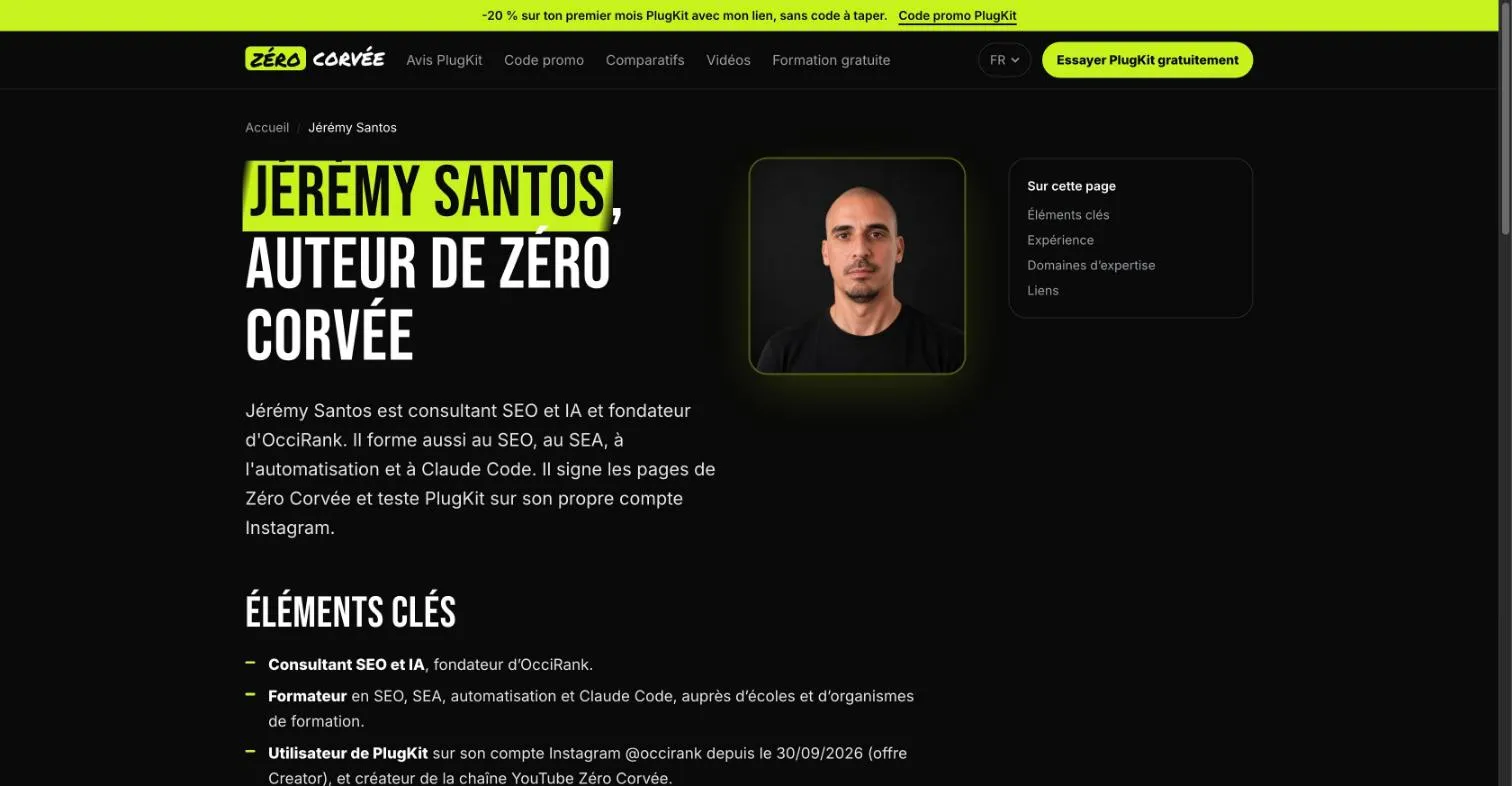
In fairness, SemChat had warned that this needed checking by eye, because its tool reads text, not images. The lesson holds for any tool: check a gap before you fix it.
An EEAT audit with SemChat: what it got right and wrong
SemChat is an SEO assistant you talk to. Its EEAT audit skill starts from a model sentence, “Mon site inspire-t-il confiance ?” (does my site inspire trust?). I asked, in French, for an audit of the about, author, contact and legal pages: who is speaking, why believe them, how to reach them, with the exact sentence behind each gap and one thing to fix first.
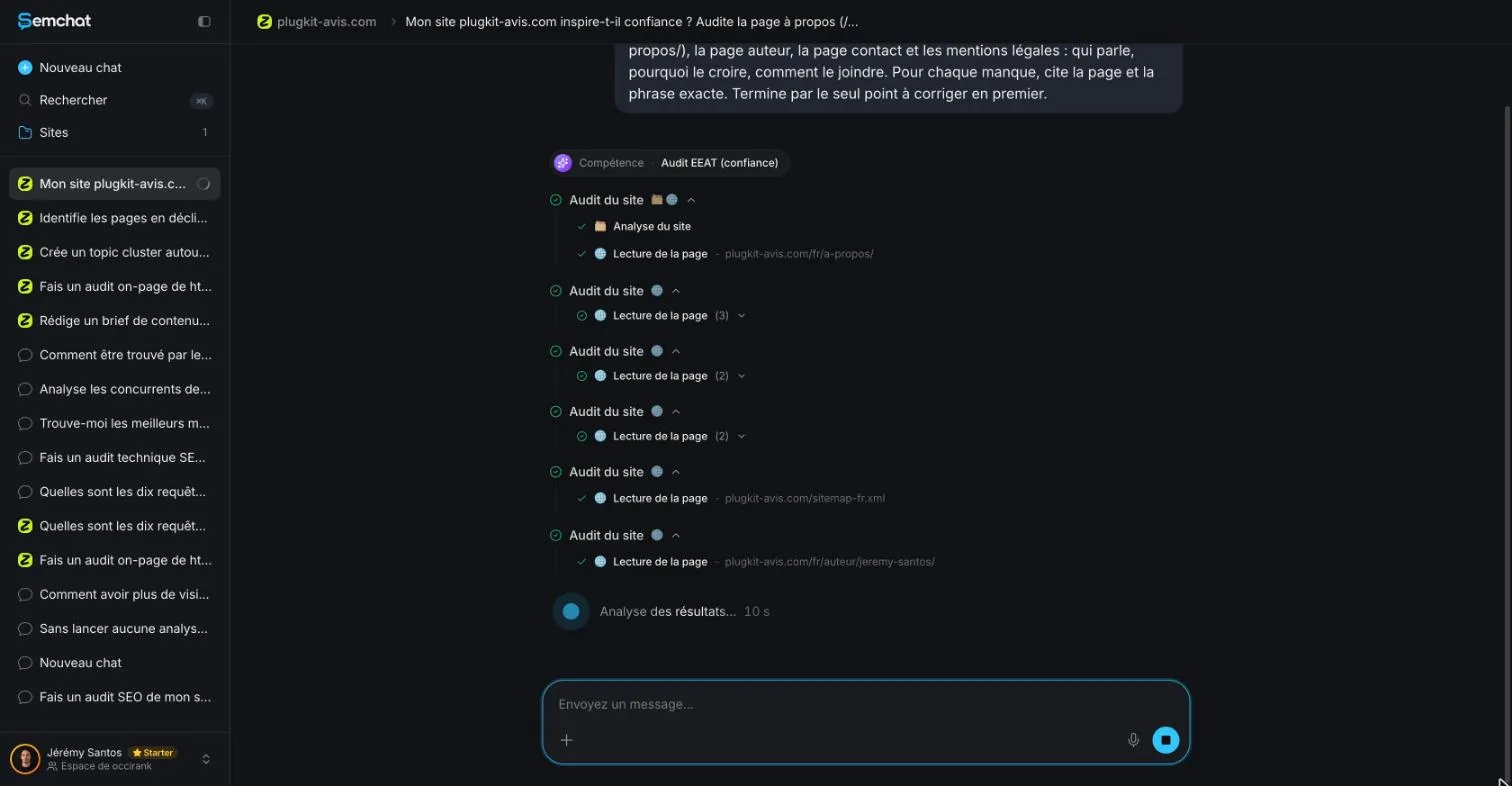
What it got right, checked the same day: all four pages name the author and the company, with the same contact details everywhere. The pages’ sharing image is the site logo, not a portrait. The about page has no photo. The voice changes from page to page: “we” on the about page, “I” on the contact page, the third person on the author page.
It also said the brand didn’t show up in Google’s top 20 for “Zéro Corvée PlugKit.” A DataForSEO check the same day found it missing from the top 10, which agrees. What it got wrong was its first point, shown above.
My verdict: a good reading grid, which talks about your site instead of reciting a definition. I tested it on the Starter plan; the Free plan at €0 gives access to the same skills, since every plan includes all features (pricing page read 29 October 2026). The plans are compared on our SemChat pricing page.
That’s the EEAT meaning in practice: trust first, then proof of what you’ve lived, an author who signs and dated sources. No checkbox does that for you. It’s what makes a stranger believe you. Start with your author page and your contact page, then reread your three most visited pages with Google’s questions: who, how, why.
Frequently asked questions
What does EEAT stand for?
Experience, Expertise, Authoritativeness and Trustworthiness. Google writes it E-E-A-T, with hyphens; most people search for EEAT. Both mean the same thing. Before December 2022, it was E-A-T, without the first E.
Does EEAT still matter with AI search?
Yes, as far as Google's own AI features go. Google writes that “The best practices for SEO remain relevant for AI features in Google Search (such as AI Overviews and AI Mode)” and that there are “no additional requirements” to appear in them (page read 30 October 2026). Google says nothing there about other assistants such as ChatGPT.
Can EEAT alone get a page to the top of Google?
No. Google writes that its systems use “many different factors” to rank content, and that E-E-A-T itself “isn't a specific ranking factor.” A trustworthy page still has to answer the search better than the others.
Does building EEAT cost money?
Most of it costs time, not money: an author page, a contact page, dated sources, photos of your own work. A tool can help you spot gaps. SemChat's Free plan is at €0 with every feature, only the monthly usage changes (pricing page read 29 October 2026).
Let your AI do the chores of getting found online.
10% off your subscription, for life with my link, if you subscribe within 2 weeks of signing up. No code. All about the SemChat promo code
Affiliate link: it costs you nothing extra.
Verified sources
- Google Search Central: creating helpful, reliable, people-first content (30/10/2026)
- Google: Search Quality Evaluator Guidelines (PDF, version of September 11, 2025) (30/10/2026)
- Google Search Central Blog (December 15, 2022): our latest update to the quality rater guidelines, E-A-T gets an extra E for experience (30/10/2026)
- Google Search Central: SEO Starter Guide (30/10/2026)
- Google Search Central: AI features and your website (30/10/2026)
- Haloscan: installing the Haloscan MCP (tutorial of September 8, 2025, in French) (29/10/2026)
- SemChat pricing (Free plan at €0, all features in every plan) (29/10/2026)